
 Contact
 Comment faire ses achats
Livraison
Guide d'achat
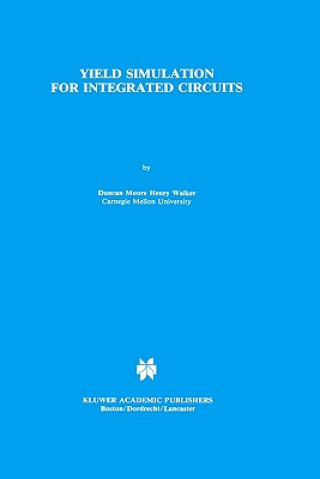
Yield Simulation for Integrated Circuits
 Anglais
 394 b
394 b
 Livraison à Autriche
Jusqu'à 30 jours pour les retours
Les clients ont également acheté




 /
/
 Livre de poche
 27.99
€
27.99
€




 /
Livre
18.89
€
/
Livre
18.89
€








In the summer of 1981 I was asked to consider the possibility of manufacturing a 600,000 transistor microprocessor in 1985. It was clear that the technology would only be capable of manufacturing 100,000-200,000 transistor chips with acceptable yields. The control store ROM occupied approximately half of the chip area, so I considered adding spare rows and columns to increase ROM yield. Laser-programmed polysilicon fuses would be used to switch between good and bad circuits. Since only half the chip area would have redundancy, I was concerned that the increase in yield would not outweigh the increased costs of testing and redundancy programming. The fabrication technology did not yet exist, so I was unable to experimentally verify the benefits of redundancy. When the technology did become available, it would be too late in the development schedule to spend time running test chips. The yield analysis had to be done analytically or by simulation. Analytic yield analysis techniques did not offer sufficient accuracy for dealing with complex structures. The simulation techniques then available were very labor-intensive and seemed more suitable for redundant memories and other very regular structures [Stapper 80J. I wanted a simulator that would allow me to evaluate the yield of arbitrary redundant layouts, hence I termed such a simulator a layout or yield simulator. Since I was unable to convince anyone to build such a simulator for me, I embarked on the research myself.


À propos du livre
Anglais
Catégories

Offrez ce livre dès aujourd'hui
C’est simple
1 Ajouter au panier et choisir l'option Livrer comme cadeau à la caisse. 2 Nous vous enverrons un bon d'achat 3 Le livre arrivera à l'adresse du destinataireCeci pourrait également vous intéresser
 /
Livre de poche
32.79
€
/
Livre de poche
32.79
€




 /
Livre relié
94.69
€
/
Livre relié
224.29
€
/
Livre relié
94.69
€
/
Livre relié
224.29
€
 /
Livre de poche
10.09
€
/
Livre de poche
10.09
€












Bonjour ! Je suis Libroamiko, votre conseiller littéraire.
Comment puis-je vous aider ?