
 Contact
 Comment faire ses achats
Livraison
Guide d'achat
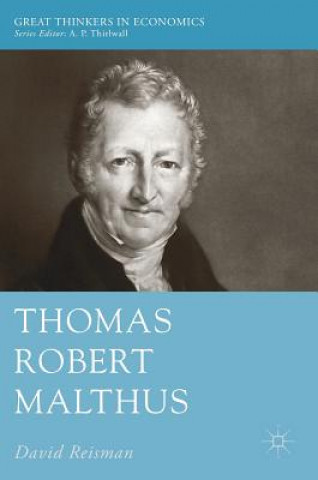
Thomas Robert Malthus
 Anglais
 253 b
253 b
 Livraison à Autriche
Jusqu'à 30 jours pour les retours
Les clients ont également acheté













Thomas Robert Malthus (1766-1834) was a leading figure in the British classical school of economics, best-known for extending the insights of Adam Smith at a time of revolutionary improvements in agriculture and industry. This book explores the way in which he accounted for the tendency to overpopulation, the exhaustion of arable land and the deficiency of effective demand. Malthus relied on historical and empirical evidence in the spirit of Bacon and Hume, but also backed up his data with a priori hypotheses that link him to his contemporary, David Ricardo. Malthus was strongly in favour of free trade, the minimal State, the gold standard and the abolition of poverty relief. Always a pragmatist, however, he was just as much in favour of public education, contra-cyclical public works and a safety net of tariffs and bounties to encourage national self-sufficiency with regard to food. He was both an economist and a clergyman and saw the two roles as interconnected. Malthus believed that a benevolent Deity had created vice and misery in order to shake human beings out of their natural indolence that would otherwise have condemned them to still greater distress. This title provides a clear and comprehensive examination of Malthus's economic and social thought. It will be of interest to students and scholars alike.


À propos du livre
Anglais

Offrez ce livre dès aujourd'hui
C’est simple
1 Ajouter au panier et choisir l'option Livrer comme cadeau à la caisse. 2 Nous vous enverrons un bon d'achat 3 Le livre arrivera à l'adresse du destinataireCeci pourrait également vous intéresser

 /
/
 Livre de poche
 29.79
€
29.79
€

 /
Livre de poche
10.69
€
/
Livre de poche
10.69
€

 /
Livre de poche
24.79
€
/
Livre de poche
24.79
€







Bonjour ! Je suis Libroamiko, votre conseiller littéraire.
Comment puis-je vous aider ?