
 Contact
 Comment faire ses achats
Livraison
Guide d'achat
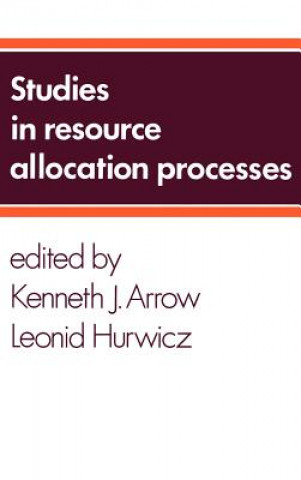
Studies in Resource Allocation Processes
 Anglais
 453 b
453 b
 Livraison à Autriche
Jusqu'à 30 jours pour les retours
Les clients ont également acheté


 /
/
 Livre relié
 29.29
€
29.29
€













 /
Livre relié
40.89
€
/
Livre relié
40.89
€












One of the central questions of economics relates to the coordination of individual units within a large organization to achieve the central objectives of that organization. This book examines the problems involved in allocating resources in an economic system where decision-making is decentralized into the hands of individuals and individual enterprises. The decisions made by these economic agents must be coordinated because the input decisions of some must eventually equal the output decisions of others. Coordination arises naturally out of the mathematical theory of optimization but there is still the question of how it can be achieved in practice with dispersed knowledge. The essays here explore the many facets of this problem. Nine papers are grouped under the title 'Economies with a single maximand'. They include papers on static and dynamic optimization, decentralization within firms, and nonconvexities in optimizing problems. Fourteen papers are concerned with 'Economies with multiple objectives'. Among the topics covered here are stability of competitive equilibrium, stability in oligopology, and dynamic shortages. The final part of the book includes three papers on informational efficiency and informationally decentralized systems. Leonid Hurwitcz is the Nobel Prize Winner 2007 for The Sveriges Riksbank Prize in Economic Sciences in Memory of Alfred Nobel, along with colleagues Eric Maskin and Roger Myerson, for his work on the effectiveness of markets.


À propos du livre
Anglais
Catégories

Offrez ce livre dès aujourd'hui
C’est simple
1 Ajouter au panier et choisir l'option Livrer comme cadeau à la caisse. 2 Nous vous enverrons un bon d'achat 3 Le livre arrivera à l'adresse du destinataireCeci pourrait également vous intéresser




 /
Livre de poche
11.59
€
/
Livre de poche
11.59
€

 /
Livre de poche
20.09
€
/
Livre de poche
20.09
€
 /
Livre de poche
20.09
€
/
Livre de poche
20.09
€













 /
Livre de poche
56.79
€
/
Livre de poche
56.79
€

Bonjour ! Je suis Libroamiko, votre conseiller littéraire.
Comment puis-je vous aider ?