
 Contact
 Comment faire ses achats
Livraison
Guide d'achat
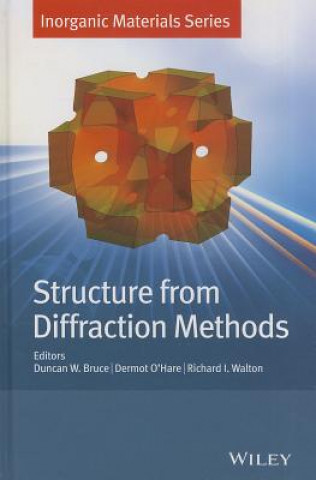
Structure from Diffraction Methods - Inorganic Materials Series
 Anglais
 284 b
284 b
 Livraison à Autriche
Jusqu'à 30 jours pour les retours
Les clients ont également acheté
 /
/
 Livre de poche
 97.59
€
97.59
€




 /
Livre de poche
37.29
€
/
Livre de poche
37.29
€

 /
Livre relié
38.29
€
/
Livre relié
38.29
€

 /
Livre de poche
18.95
€
/
Livre de poche
18.95
€

Inorganic materials show a diverse range of important properties that are desirable for many contemporary, real-world applications. Good examples include recyclable battery cathode materials for energy storage and transport, porous solids for capture and storage of gases and molecular complexes for use in electronic devices. An understanding of the function of these materials is necessary in order to optimise their behaviour for real applications, hence the importance of 'structure--property relationships'. The chapters presented in this volume deal with recent advances in the characterisation of crystalline materials. They include some familiar diffraction methods, thoroughly updated with modern advances. Also included are techniques that can now probe details of the three-dimensional arrangements of atoms in nanocrystalline solids, allowing aspects of disorder to be studied. Small-angle scattering, a technique that is often overlooked, can probe the ordered structure of materials below the length scale of powder diffraction methods. Addressing both physical principals and recent advances in their applications, Structure from Diffraction Methods covers: Powder Diffraction X-Ray and Neutron Single-Crystal Diffraction PDF Analysis of Nanoparticles Electron Crystallography Small-Angle Scattering Ideal as a complementary reference work to other volumes in the series ( Local Structural Characterisation and Multi Length-Scale Characterisation ), or as an examination of the specific characterisation techniques in their own right, Structure from Diffraction Methods is a valuable addition to the Inorganic Materials Series . Send


À propos du livre
Anglais

Offrez ce livre dès aujourd'hui
C’est simple
1 Ajouter au panier et choisir l'option Livrer comme cadeau à la caisse. 2 Nous vous enverrons un bon d'achat 3 Le livre arrivera à l'adresse du destinataireCeci pourrait également vous intéresser







 /
Livre de poche
30.19
€
/
Livre de poche
30.19
€
 /
Livre relié
47.49
€
/
Livre relié
47.49
€




 /
Livre relié
85.59
€
/
Livre relié
85.59
€







Bonjour ! Je suis Libroamiko, votre conseiller littéraire.
Comment puis-je vous aider ?