
 Contact
 Comment faire ses achats
Livraison
Guide d'achat
Protostellar Jets in Context
 Anglais
 746 b
746 b
 Livraison à Autriche
Jusqu'à 30 jours pour les retours
Les clients ont également acheté







 /
/
 Livre de poche
 18.95
€
18.95
€























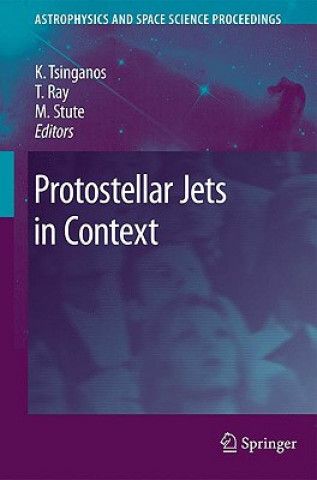
It is over a quarter of a century since the discovery of out?ows from young stars. The intervening years have led to remarkable advances in our understanding of this phenomenon. Much of the progress can be attributed to advances in facilities and technologies, including not only larger telescopes but also improved instrument and detector performance. In addition protostellar out?ows have now been imaged from the ground and space at high spatial resolution, e. g. with HST, and at a wide - riety of wavelengths from X-rays to radio waves, revealing more and more about their physics. This veritable revolution in observation has been accompanied by an exponential growth in our ability to numerically simulate the launching and pro- gation of jets. Codes continue to improve: they now incorporate more physics and are increasingly ef?cient through, for example, techniques such as adaptive mesh re?nement and the use of parallel processing in cluster environments. Simulating the launching and propagation of a jet all the way from the vicinity of the star up to 4 several thousand AU (a size range of10 ) is now much closer. In more recent times, developments in observation, theory and numerical s- ulation have been joined by laboratory jet experiments reproducing, on centimetre scales, that which is seen in astrophysics to stretch for several parsecs.


À propos du livre
Anglais

Offrez ce livre dès aujourd'hui
C’est simple
1 Ajouter au panier et choisir l'option Livrer comme cadeau à la caisse. 2 Nous vous enverrons un bon d'achat 3 Le livre arrivera à l'adresse du destinataireCeci pourrait également vous intéresser

 /
Livre relié
214.29
€
/
Livre relié
214.29
€







 /
Livre de poche
35.09
€
/
Livre de poche
35.09
€














 /
Livre de poche
50.19
€
/
Livre de poche
50.19
€
Bonjour ! Je suis Libroamiko, votre conseiller littéraire.
Comment puis-je vous aider ?