
 Contact
 Comment faire ses achats
Livraison
Guide d'achat
 Anglais
 524 b
524 b
 Livraison à Autriche
Jusqu'à 30 jours pour les retours
Les clients ont également acheté















 /
/
 Livre de poche
 51.99
€
51.99
€




 /
Livre de poche
44.39
€
/
Livre de poche
44.39
€











 /
Livre de poche
39.59
€
/
Livre de poche
39.59
€


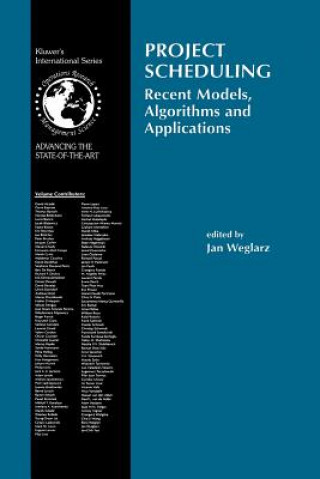
Project scheduling problems are, generally speaking, the problems of allocating scarce resources over time to perform a given set of activities. The resources are nothing other than the arbitrary means which activities complete for. Also the activities can have a variety of interpretations. Thus, project scheduling problems appear in a large spectrum of real-world situations, and, in consequence, they have been intensively studied for almost fourty years. Almost a decade has passed since the multi-author monograph: R. Slowinski, 1. W~glarz (eds. ), Advances in Project Scheduling, Elsevier, 1989, summarizing the state-of-the-art across project scheduling problems, was published. Since then, considerable progress has been made in all directions of modelling and finding solutions to these problems. Thus, the proposal by Professor Frederick S. Hillier to edit a handbook which reports on the recent advances in the field came at an exceptionally good time and motivated me to accept the challenge. Fortunately, almost all leading experts in the field have accepted my invitation and presented their completely new advances often combined with expository surveys. Thanks to them, the handbook stands a good chance of becoming a key reference point on the current state-of-the-art in project scheduling, as well as on new directions in the area. The contents are divided into four parts. The first one, dealing with classical models -exact algorithms, is preceded by a proposition of the classification scheme for scheduling problems.


À propos du livre
Anglais

Offrez ce livre dès aujourd'hui
C’est simple
1 Ajouter au panier et choisir l'option Livrer comme cadeau à la caisse. 2 Nous vous enverrons un bon d'achat 3 Le livre arrivera à l'adresse du destinataireCeci pourrait également vous intéresser






 /
Livre de poche
14.79
€
/
Livre de poche
14.79
€
 /
Livre de poche
31.59
€
/
Livre de poche
31.59
€







 /
Livre de poche
31.99
€
/
Livre de poche
31.99
€








Bonjour ! Je suis Libroamiko, votre conseiller littéraire.
Comment puis-je vous aider ?