
 Contact
 Comment faire ses achats
Livraison
Guide d'achat
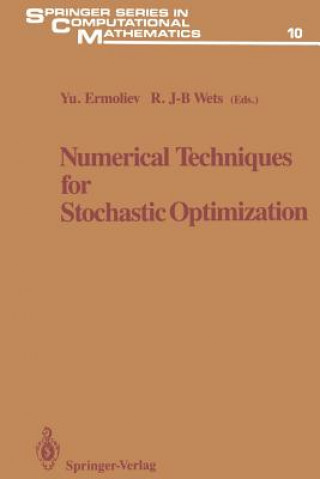
Numerical Techniques for Stochastic Optimization
 Anglais
 132 b
132 b
 Livraison à Autriche
Jusqu'à 30 jours pour les retours
Les clients ont également acheté


 /
/
 Livre de poche
 46.59
€
46.59
€
 /
Livre de poche
33.59
€
/
Livre de poche
33.59
€







 /
Livre de poche
14.99
€
/
Livre de poche
14.99
€


 /
Livre de poche
15.39
€
/
Livre de poche
15.39
€




 /
Livre de poche
77.29
€
/
Livre de poche
77.29
€


 /
Livre de poche
31.29
€
/
Livre de poche
31.29
€









 /
Livre de poche
22.79
€
/
Livre de poche
22.79
€

Rapid changes in today's environment emphasize the need for models and meth ods capable of dealing with the uncertainty inherent in virtually all systems re lated to economics, meteorology, demography, ecology, etc. Systems involving interactions between man, nature and technology are subject to disturbances which may be unlike anything which has been experienced in the past. In the technological revolution increases uncertainty-as each new stage particular, perturbs existing knowledge of structures, limitations and constraints. At the same time, many systems are often too complex to allow for precise measure ment of the parameters or the state of the system. Uncertainty, nonstationarity, disequilibrium are pervasivE' characteristics of most modern systems. In order to manage such situations (or to survive in such an environment) we must develop systems which can facilitate oar response to uncertainty and changing conditions. In our individual behavior we often follow guidelines that are conditioned by the need to be prepared for all (likely) eventualities: insur ance, wearing seat·belts, savings versus investments, annual medical check.ups, even keeping an umbrella at the office, etc. One can identify two major types of mechanisms: the short term adaptive adjustments (defensive driving, mar keting, inventory control, etc.) that are made after making some observations of the system's parameters, and the long term anticipative actions (engineer ing design, policy setting, allocation of resources, investment strategies, etc.).


À propos du livre
Anglais

Offrez ce livre dès aujourd'hui
C’est simple
1 Ajouter au panier et choisir l'option Livrer comme cadeau à la caisse. 2 Nous vous enverrons un bon d'achat 3 Le livre arrivera à l'adresse du destinataireCeci pourrait également vous intéresser



 /
Livre de poche
11.59
€
/
Livre de poche
11.59
€





 /
Livre de poche
152.99
€
/
Livre de poche
7.99
€
/
Livre de poche
152.99
€
/
Livre de poche
7.99
€


 /
Livre de poche
21.99
€
/
Livre de poche
21.99
€






 /
Livre de poche
21.99
€
/
Livre de poche
21.99
€



Bonjour ! Je suis Libroamiko, votre conseiller littéraire.
Comment puis-je vous aider ?