
 Contact
 Comment faire ses achats
Livraison
Guide d'achat
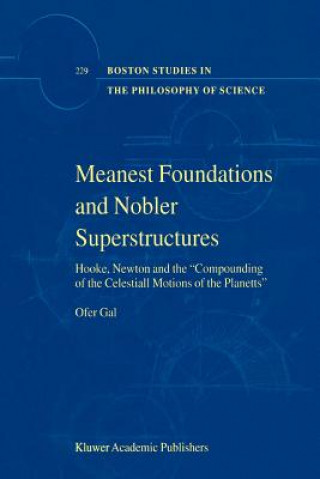
Meanest Foundations and Nobler Superstructures
Hooke, Newton and the Compounding of the Celestiall Motions of the Planetts
 Anglais
 236 b
236 b
 Livraison à Autriche
Jusqu'à 30 jours pour les retours
Les clients ont également acheté

 /
/
 Livre de poche
 17.95
€
17.95
€





 /
Livre de poche
35.79
€
/
Livre de poche
35.79
€






















 /
Livre de poche
122.19
€
/
Livre de poche
122.19
€

This book is a historical-epistemological study of one the most consequential idea of early modern celestial mechanics: Robert Hooke's proposal to "compoun[d] the celestial motions of the planets of a direct motion by the tangent & an attractive motion towards a central body," a proposal which Isaac Newton adopted and realized in his Principia. §Hooke's Programme was revolutionary both cosmologically and mathematically. It presented "the celestial motions," the proverbial symbol of stability and immutability, as a process of continuous change, and prescribed only parameters of rectilinear motions and rectilinear attractions for calculating their closed curved orbits. Yet the traces of Hooke's construction of his Programme for the heavens lead through his investigations in such earthly disciplines as microscopy, practical optics and horology, and the mathematical tools developed by Newton to accomplish it appear no less local and goal-oriented than Hooke's lenses and springs.§This transgression of the boundaries between the theoretical, experimental and technological realms is reminiscent of Hooke's own free excursions in and out of the circles occupied by gentlemen-philosophers, university mathematicians, instrument makers, technicians and servants. It presents an opportunity to examine the social and epistemological distinctions, relations and hierarchies between those realms and their inhabitants, and compels a critical assessment of the philosophical categories they embody.This book is a historical-epistemological study of one the most consequential idea of early modern celestial mechanics: Robert Hooke's proposal to "compoun[d] the celestial motions of the planets of a direct motion by the tangent & an attractive motion towards a central body," a proposal which Isaac Newton adopted and realized in his Principia.§Hooke's Programme was revolutionary both cosmologically and mathematically. It presented "the celestial motions," the proverbial symbol of stability and immutability, as a process of continuous change, and prescribed only parameters of rectilinear motions and rectilinear attractions for calculating their closed curved orbits. Yet the traces of Hooke's construction of his Programme for the heavens lead through his investigations in such earthly disciplines as microscopy, practical optics and horology, and the mathematical tools developed by Newton to accomplish it appear no less local and goal-oriented than Hooke's lenses and springs.§This transgression of the boundaries between the theoretical, experimental and technological realms is reminiscent of Hooke's own free excursions in and out of the circles occupied by gentlemen-philosophers, university mathematicians, instrument makers, technicians and servants. It presents an opportunity to examine the social and epistemological distinctions, relations and hierarchies between those realms and their inhabitants, and compels a critical assessment of the philosophical categories they embody.


À propos du livre
Anglais

Offrez ce livre dès aujourd'hui
C’est simple
1 Ajouter au panier et choisir l'option Livrer comme cadeau à la caisse. 2 Nous vous enverrons un bon d'achat 3 Le livre arrivera à l'adresse du destinataireCeci pourrait également vous intéresser




 /
Livre de poche
15.39
€
/
Livre de poche
15.39
€












 /
Livre de poche
12.99
€
/
Livre de poche
12.99
€


 /
Livre de poche
6.99
€
/
Livre de poche
6.99
€



Bonjour ! Je suis Libroamiko, votre conseiller littéraire.
Comment puis-je vous aider ?