
 Contact
 Comment faire ses achats
Livraison
Guide d'achat
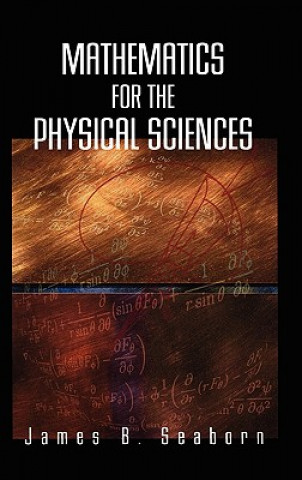
Mathematics for the Physical Sciences
 Anglais
 122 b
122 b
 Livraison à Autriche
Jusqu'à 30 jours pour les retours
Les clients ont également acheté










 /
/
 Livre de poche
 8.09
€
8.09
€








The book provides a bridge from courses in general physics to the intermediate-level courses in classical mechanics, electrodynamics and quantum mechanics. The author bases the mathematical discussions on specific physical problems to provide a basis for developing mathematical intuition.This book is intended to provide a bridge from courses in general physics to the intermediate -level courses in classical mechanics, electrodynamics and quantum mechanics. It begins with a short review of some topics in physics that are then used throughout the book to provide the physical contexts for the mathematical methods that are developed: electrostatics, electric currents, magnetic flux, simple harmonic motion, and the rigid rotor. The next chapters treat vector algebra and vector calculus; the concept of magnetic flux serves to give physical meaning to the integral theorems. A short chapter on complex numbers provides the needed background for the remainder of the text. Ordinary differential equations arise in may physical contexts; the simple harmonic oscillator serves as the illustrative example. Examples from both classical and quantum physics illustrate the chapters on partial differential equations and eigenvalue problems: the quantum harmonic oscillator and a particle in a box, a conducting sphere in a uniform field and a vibrating drum head. The eigenvalue problem leads naturally to a discussion of orthogonal functions, which again use the quantum harmonic oscillator to provide the physical insight, and to matrices, where coupled oscillators and the principal axes of a rotating rigid body provide the physical context. The text concludes with a brief discussion of variational methods and the Euler-Lagrange equation. Problems at the end of each chapter give the student experience in applying mathematical methods to the solution of physical problems. Illustrative exercises throughout provide guidance. Many of the exercises call for graphical representations, and some are particularly amenable to the use of numerical methods.


À propos du livre
Anglais

Offrez ce livre dès aujourd'hui
C’est simple
1 Ajouter au panier et choisir l'option Livrer comme cadeau à la caisse. 2 Nous vous enverrons un bon d'achat 3 Le livre arrivera à l'adresse du destinataireCeci pourrait également vous intéresser











 /
Livre relié
170.29
€
/
Livre relié
170.29
€


 /
Livre de poche
19.99
€
/
Livre de poche
19.99
€



 /
Livre de poche
62.09
€
/
Livre de poche
62.09
€



 /
Livre relié
180.79
€
/
Livre relié
180.79
€
 /
Livre de poche
16.29
€
/
Livre de poche
16.29
€
Bonjour ! Je suis Libroamiko, votre conseiller littéraire.
Comment puis-je vous aider ?