
 Contact
 Comment faire ses achats
Livraison
Guide d'achat
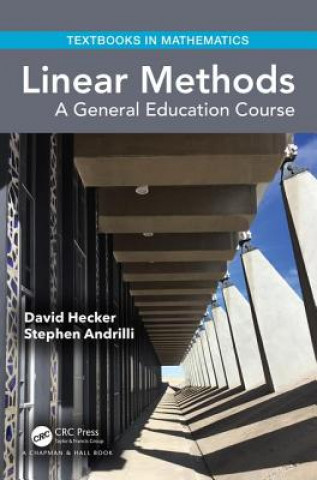
Linear Methods
 Anglais
 344 b
344 b
 Livraison à Autriche
Jusqu'à 30 jours pour les retours
Les clients ont également acheté









 /
/
 Livre de poche
 15.99
€
15.99
€




 /
Livre de poche
46.59
€
/
Livre de poche
46.59
€




 /
Livre de poche
17.95
€
/
Livre de poche
17.95
€









Linear Methods: A General Education Course is expressly written for non-mathematical students, particularly freshmen taking a required core mathematics course. Rather than covering a hodgepodge of different topics as is typical for a core mathematics course, this text encourages students to explore one particular branch of mathematics, elementary linear algebra, in some depth. The material is presented in an accessible manner, as opposed to a traditional overly rigorous approach. While introducing students to useful topics in linear algebra, the book also includes a gentle introduction to more abstract facets of the subject.
Many relevant uses of linear algebra in today’s world are illustrated, including applications involving business, economics, elementary graph theory, Markov chains, linear regression and least-squares polynomials, geometric transformations, and elementary physics. The authors have included proofs of various important elementary theorems and properties which provide readers with the reasoning behind these results.
Features:
- Written for a general education core course in introductory mathematics
- Introduces elementary linear algebra concepts to non-mathematics majors
- Provides an informal introduction to elementary proofs involving matrices and vectors
- Includes useful applications from linear algebra related to business, graph theory, regression, and elementary physics
Authors Bio:
David Hecker is a Professor of Mathematics at Saint Joseph''s University in Philadelphia. He received his Ph.D. from Rutgers University and has published several journal articles. He also co-authored several editions of Elementary Linear Algebra with Stephen Andrilli.
Stephen Andrilli is a Professor in the Mathematics and Computer Science Department at La Salle University in Philadelphia. He received his Ph.D. from Rutgers University and also co-authored several editions of Elementary Linear Algebra with David Hecker.


À propos du livre
Anglais
Catégories

Offrez ce livre dès aujourd'hui
C’est simple
1 Ajouter au panier et choisir l'option Livrer comme cadeau à la caisse. 2 Nous vous enverrons un bon d'achat 3 Le livre arrivera à l'adresse du destinataireCeci pourrait également vous intéresser



 /
Livre de poche
21.99
€
/
Livre de poche
21.99
€

 /
Livre de poche
19.69
€
/
Livre de poche
19.69
€

 /
Livre relié
37.69
€
/
Livre relié
37.69
€










Bonjour ! Je suis Libroamiko, votre conseiller littéraire.
Comment puis-je vous aider ?