
 Contact
 Comment faire ses achats
Livraison
Guide d'achat
Level Crossing Methods in Stochastic Models
 Anglais
 396 b
396 b
 Livraison à Autriche
Jusqu'à 30 jours pour les retours
Les clients ont également acheté





 /
/
 Livre de poche
 35.79
€
35.79
€


 /
Livre de poche
34.19
€
/
Livre de poche
34.19
€






 /
Livre de poche
25.99
€
/
Livre de poche
25.99
€

 /
Livre de poche
152.89
€
/
Livre de poche
152.89
€




 /
Livre de poche
20.29
€
/
Livre de poche
20.29
€

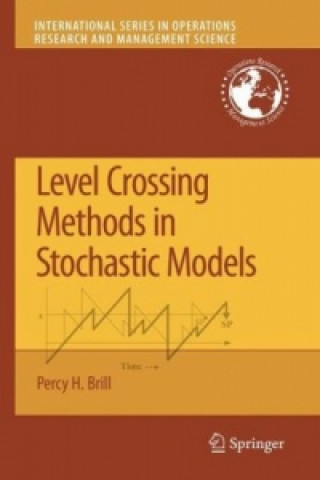
From 1972 to 1974, I was working on a PhD thesis entitled Multiple Server Queues with Service Time Depending on Waiting Time.The method of analysis was the embedded Markov chain technique, described in the papers [82] and [77]. My analysis involved lengthy, tedious deri- tions of systems of integral equations for the probability density function (pdf) of the waiting time. After pondering for many months whether there might be a faster, easier way to derive the integral equations, I ?nally discovered the basic theorems for such a method in August, 1974. The theorems establish a connection between sample-path level-crossing rates of the virtual wait process and the pdf of the waiting time. This connection was not found anywhere else in the literature at the time. I immediately developed a comprehensive new methodology for deriving the integral equations based on these theorems, and called it system point theory. (Subsequently it was called system point method,or system point level crossing method: SPLC or simply LC.) I rewrote the entire PhD thesis from November 1974 to March 1975, using LC to reach solutions. The new thesis was called System Point Theory in Exponential Queues. On June 12, 1975 I presented an invited talk on the new methodology at the Fifth Conference on Stochastic Processes and their Applications at the University of Maryland. Many queueing theorists were present.


À propos du livre
Anglais
Catégories

Offrez ce livre dès aujourd'hui
C’est simple
1 Ajouter au panier et choisir l'option Livrer comme cadeau à la caisse. 2 Nous vous enverrons un bon d'achat 3 Le livre arrivera à l'adresse du destinataireCeci pourrait également vous intéresser








 /
Livre de poche
12.39
€
/
Livre de poche
12.39
€







 /
Livre relié
25.89
€
/
Livre relié
25.89
€
 /
Livre de poche
27.49
€
/
Livre de poche
27.49
€





 /
Livre relié
85.09
€
/
Livre relié
85.09
€
Bonjour ! Je suis Libroamiko, votre conseiller littéraire.
Comment puis-je vous aider ?