
 Contact
 Comment faire ses achats
Livraison
Guide d'achat
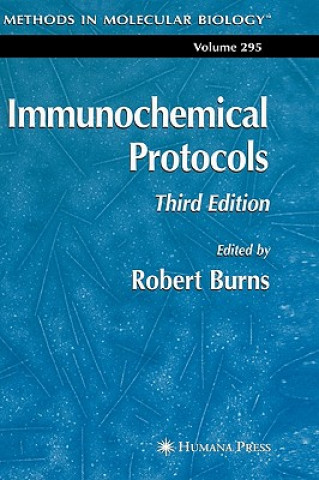
Immunochemical Protocols
 Anglais
 290 b
290 b
 Livraison à Autriche
Jusqu'à 30 jours pour les retours
Les clients ont également acheté







 /
/
 Livre de poche
 44.99
€
44.99
€


Immunochemical techniques have been in use for many years with early examples of bacterial strain typing dating back to the 1940s. The basis for the science is the exquisite elegance of the mammalian immune system with its ability to recognize foreign proteins and to manufacture antibody m- ecules that strongly bind to the substances that elicited them. Not only are potentially harmful pathogens and toxins recognized by the immune system, but the system can be persuaded to manufacture antibodies to an astonishing array of substances. In the early days of this science, all antibodies for investigative work were produced by immunizing mammals with the substance of interest, followed by regular donor bleeds that yielded antisera. Serum produced in this way yields heterogenic populations of antibody molecules recognizing different epitopes on the target protein, which may be adequate for its intended p- poses, but can also cause problems of crossreactivity. In 1975, Kohler and Milstein reported that spleen cells from immune donor animals could be immortalized, cloned from single cells, and grown in continuous culture. This original work described the method for the production of monoclonal antibodies.


À propos du livre
Anglais
Catégories

Offrez ce livre dès aujourd'hui
C’est simple
1 Ajouter au panier et choisir l'option Livrer comme cadeau à la caisse. 2 Nous vous enverrons un bon d'achat 3 Le livre arrivera à l'adresse du destinataireCeci pourrait également vous intéresser















 /
Livre de poche
17.09
€
/
Livre de poche
17.09
€




 /
Livre de poche
53.79
€
/
Livre de poche
53.79
€

 /
Livre de poche
85.09
€
/
Livre de poche
85.09
€
Bonjour ! Je suis Libroamiko, votre conseiller littéraire.
Comment puis-je vous aider ?