
 Contact
 Comment faire ses achats
Livraison
Guide d'achat
Digital Dice
 Anglais
 51 b
51 b
 Livraison à Autriche
Jusqu'à 30 jours pour les retours
Les clients ont également acheté


 /
/
 Livre de poche
 19.99
€
19.99
€
 /
Livre de poche
19.49
€
/
Livre de poche
19.49
€







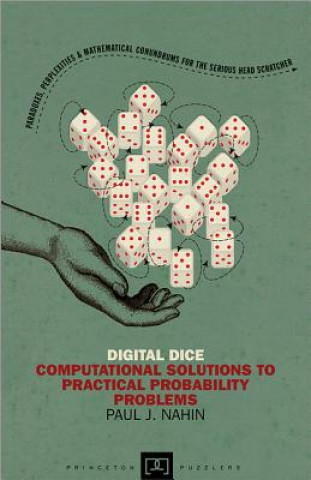
Some probability problems are so difficult that they stump the smartest mathematicians. But even the hardest of these problems can often be solved with a computer and a Monte Carlo simulation, in which a random-number generator simulates a physical process, such as a million rolls of a pair of dice. This is what Digital Dice is all about: how to get numerical answers to difficult probability problems without having to solve complicated mathematical equations. Popular-math writer Paul Nahin challenges readers to solve twenty-one difficult but fun problems, from determining the odds of coin-flipping games to figuring out the behavior of elevators. Problems build from relatively easy (deciding whether a dishwasher who breaks most of the dishes at a restaurant during a given week is clumsy or just the victim of randomness) to the very difficult (tackling branching processes of the kind that had to be solved by Manhattan Project mathematician Stanislaw Ulam). In his characteristic style, Nahin brings the problems to life with interesting and odd historical anecdotes. Readers learn, for example, not just how to determine the optimal stopping point in any selection process but that astronomer Johannes Kepler selected his second wife by interviewing eleven women. The book shows readers how to write elementary computer codes using any common programming language, and provides solutions and line-by-line walk-throughs of a MATLAB code for each problem. Digital Dice will appeal to anyone who enjoys popular math or computer science. In a new preface, Nahin wittily addresses some of the responses he received to the first edition.


À propos du livre
Anglais

Offrez ce livre dès aujourd'hui
C’est simple
1 Ajouter au panier et choisir l'option Livrer comme cadeau à la caisse. 2 Nous vous enverrons un bon d'achat 3 Le livre arrivera à l'adresse du destinataireCeci pourrait également vous intéresser




















Bonjour ! Je suis Libroamiko, votre conseiller littéraire.
Comment puis-je vous aider ?