
 Contact
 Comment faire ses achats
Livraison
Guide d'achat
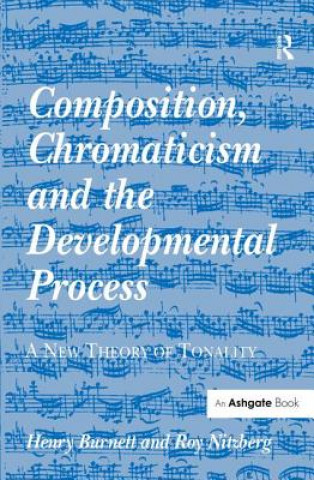
Composition, Chromaticism and the Developmental Process
A New Theory of Tonality
 Anglais
 594 b
594 b
 Livraison à Autriche
Jusqu'à 30 jours pour les retours
Les clients ont également acheté

 /
/
 Livre Concertina
 6.69
€
6.69
€


 /
Livre de poche
58.89
€
/
Livre de poche
58.89
€

























 /
Livre de poche
14.19
€
/
Livre de poche
14.19
€

Musicology, having been transmitted as a compilation of disparate events and disciplines, has long necessitated a 'magic bullet', a 'unified field theory' so to speak, that can interpret the steady metamorphosis of Western art music from late medieval modality to twentieth century atonality within a single theoretical construct. Without that magic bullet, discussions of this kind are increasingly complicated and, to make matters worse, the validity of any transformational models and ideas of the natural evolution of styles is questioned and even frowned upon today as epitomizing a grotesque teleological bigotry. Going against current thinking, Henry Burnett and Roy Nitzberg claim that the teleological approach to observing stylistic change is still valid when considered from the purely compositional perspective. The authors challenge the traditional understanding of development, and advance a new theory of eleven-pitch tonality as it relates to the corpus of Western composition. The book plots the evolution of tonality and its bearing on style and the compositional process itself. The theory is not based on the diatonic aspect of the various tonal systems exploited by composers; rather, the theory is chromatically based - the chromatically inflected octave being the source not only of a highly ingenious developmental dialectic, but also encompassing the moment-to-moment progression of the musical narrative itself. Even the most profound teachings of Schenker, and the often startlingly original and worthwhile speculations of Riemann, Tovey, Dahlhaus and others, still provide no theory of development and so are ultimately unable to unite the various tendrils of the compositional organism into a unified whole. Burnett and Nitzberg move beyond existing theory and analysis to base their theory from the standpoint of chromatic 'pitch fields'. These fields are the specific chromatic pitch choices that a composer uses to inform and design a complete composition, utilizing specific chromatic inflections to control a large-scale working out process that is the very essence of 'development'. In short, the authors claim that a chromatic background that coexists with a diatonic contrapuntal background may define the process of compositional development. These chromatic and diatonic events are the two genus expressions of slowly unfolding tonic octaves.


À propos du livre
Anglais
Catégories

Offrez ce livre dès aujourd'hui
C’est simple
1 Ajouter au panier et choisir l'option Livrer comme cadeau à la caisse. 2 Nous vous enverrons un bon d'achat 3 Le livre arrivera à l'adresse du destinataireCeci pourrait également vous intéresser
 /
Livre relié
20.99
€
/
Livre relié
20.99
€
















 /
/
 Adobe ePub DRM
78.89
€
Adobe ePub DRM
78.89
€




 /
Adobe ePub DRM
3.39
€
/
Adobe ePub DRM
3.39
€



Bonjour ! Je suis Libroamiko, votre conseiller littéraire.
Comment puis-je vous aider ?