
 Contact
 Comment faire ses achats
Livraison
Guide d'achat
 Anglais
 333 b
333 b
 Livraison à Autriche
Jusqu'à 30 jours pour les retours
Les clients ont également acheté







 /
/
 Livre de poche
 8.79
€
8.79
€


















 /
Livre relié
32.75
€
/
Livre relié
32.75
€



 /
Livre de poche
47.95
€
/
Livre de poche
47.95
€

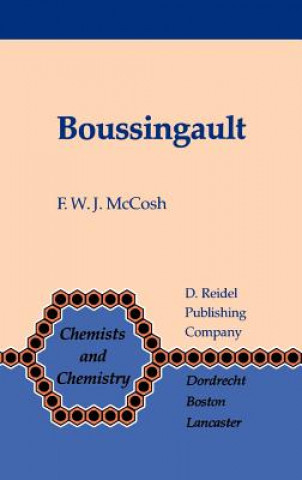
It was the British music critic Neville Cardus, writing on Debussy, who remarked how "the great sea of Wagner threatened to overwhelm the world of nineteenth century music". 1 There is an analogy in mid-nineteenth century agriculture where the great sea of Justus von Liebig developed a tidal wave which to this day conceals much of the original work and merit of others in the same field. Not only the general public but even students of agriculture may, or may not, recall the names of Persoz, Kuhlmann and Ville in France, Thaer and Sprengel in Germany, or even Lawes and Gilbert in England, to mention a few of them, whose pioneer works were not pub licised in the same didactic and polemical manner as those of Liebig. Among such pioneers was Jean Baptiste Boussingault (1802-1887) whose funda mental researches contributed to the emergence of agriculture from an empirical corpus of facts to the status of a science. Yet apart from his work in animal and crop science he also engaged in metallurgical investigations, biology and pure chemistry. The scientific world was already approaching the end of an era in which it was possible to embrace several disciplines adequately. With increasing specialisation, institutionalism and profeSsionalism in science the polymath was a gradually disappearing species.


À propos du livre
Anglais

Offrez ce livre dès aujourd'hui
C’est simple
1 Ajouter au panier et choisir l'option Livrer comme cadeau à la caisse. 2 Nous vous enverrons un bon d'achat 3 Le livre arrivera à l'adresse du destinataireCeci pourrait également vous intéresser



 /
Livre de poche
56.09
€
/
Livre de poche
56.09
€










 /
Livre de poche
8.89
€
/
Livre de poche
8.89
€


 /
Livre de poche
6.79
€
/
Livre de poche
6.79
€




Bonjour ! Je suis Libroamiko, votre conseiller littéraire.
Comment puis-je vous aider ?