Contact
 Comment faire ses achats
Livraison
Guide d'achat
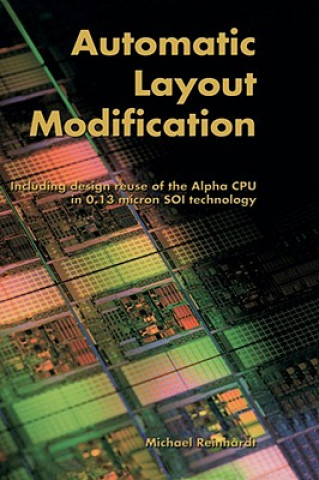
Automatic Layout Modification
Including Design Reuse of the Alpha CPU in 0.13 Micron SOI Technology
 Anglais
 290 b
290 b
 Livraison à Autriche
Jusqu'à 30 jours pour les retours
Les clients ont également acheté

 /
/
 Livre
Livre
 19.99
€
19.99
€











 /
Livre de poche
34.29
€
/
Livre de poche
34.29
€







Design reuse techniques have become the subject of books, conferences, and podium discussions over the last few years. However, most discussions focus on higher-level abstraction like RTL descriptions, which can be synthesized. Design reuse is often seen as an add-on to normal design activity, or a special design task that is not an integrated part of the existing design flow. This may all be true for the ASIC world, but not for high-speed, high-performance microprocessors. In the field of high-speed microprocessors, design reuse is an integrated part of the design flow. The method of choice in this demanding field was, and is always, physical design reuse at the layout level. In the past, the practical implementations of this method were linear shrinks and the lambda approach. With the scaling of process technology down to 0.18 micron and below, this approach lost steam and became inefficient. The only viable solution is a method, which is now called Automatic Layout Modification (ALM). It combines compaction, mask manipulation, and correction with powerful capabilities. Automatic Layout Modification, Including design reuse of the Alpha CPU in 0.13 micron SOI technology is a welcome effort to improving some of the practices in chip design today.


À propos du livre
Anglais
Catégories

Offrez ce livre dès aujourd'hui
C’est simple
1 Ajouter au panier et choisir l'option Livrer comme cadeau à la caisse. 2 Nous vous enverrons un bon d'achat 3 Le livre arrivera à l'adresse du destinataireCeci pourrait également vous intéresser






 /
Livre de poche
11.59
€
/
Livre de poche
11.59
€
 /
Livre de poche
16.29
€
/
Livre de poche
16.29
€
 /
Livre de poche
19.89
€
/
Livre de poche
19.89
€










 /
Livre de poche
107.29
€
/
Livre de poche
107.29
€