
 Contact
 Comment faire ses achats
Livraison
Guide d'achat
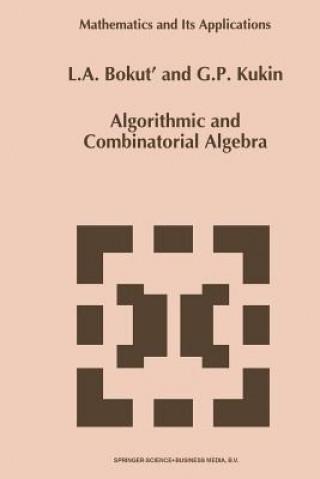
Algorithmic and Combinatorial Algebra
 Anglais
 263 b
263 b
 Livraison à Autriche
Jusqu'à 30 jours pour les retours
Les clients ont également acheté




 /
/
 Livre relié
 25.99
€
25.99
€

 /
/
 Calendrier
20.99
€
Calendrier
20.99
€

Even three decades ago, the words 'combinatorial algebra' contrasting, for in stance, the words 'combinatorial topology,' were not a common designation for some branch of mathematics. The collocation 'combinatorial group theory' seems to ap pear first as the title of the book by A. Karras, W. Magnus, and D. Solitar [182] and, later on, it served as the title of the book by R. C. Lyndon and P. Schupp [247]. Nowadays, specialists do not question the existence of 'combinatorial algebra' as a special algebraic activity. The activity is distinguished not only by its objects of research (that are effectively given to some extent) but also by its methods (ef fective to some extent). To be more exact, we could approximately define the term 'combinatorial algebra' for the purposes of this book, as follows: So we call a part of algebra dealing with groups, semi groups , associative algebras, Lie algebras, and other algebraic systems which are given by generators and defining relations {in the first and particular place, free groups, semigroups, algebras, etc. )j a part in which we study universal constructions, viz. free products, lINN-extensions, etc. j and, finally, a part where specific methods such as the Composition Method (in other words, the Diamond Lemma, see [49]) are applied. Surely, the above explanation is far from covering the full scope of the term (compare the prefaces to the books mentioned above).


À propos du livre
Anglais

Offrez ce livre dès aujourd'hui
C’est simple
1 Ajouter au panier et choisir l'option Livrer comme cadeau à la caisse. 2 Nous vous enverrons un bon d'achat 3 Le livre arrivera à l'adresse du destinataireCeci pourrait également vous intéresser




 /
Livre de poche
26.89
€
/
Livre de poche
26.89
€

 /
Livre de poche
7.99
€
/
Livre de poche
7.99
€






 /
Livre relié
47.49
€
/
Livre relié
47.49
€




Bonjour ! Je suis Libroamiko, votre conseiller littéraire.
Comment puis-je vous aider ?