
 Contact
 Comment faire ses achats
Livraison
Guide d'achat
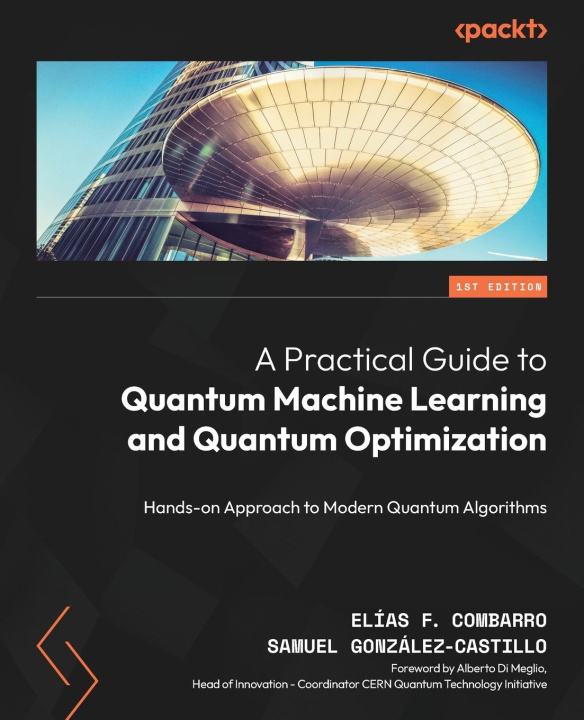
A Practical Guide to Quantum Machine Learning and Quantum Optimisation
 Anglais
 138 b
138 b
 Livraison à Autriche
Politique de retour sous 30 jours
Les clients ont également acheté
 /
/
 Livre de poche
 46.49
€
46.49
€
 /
Livre de poche
57.49
€
/
Livre de poche
57.49
€

 /
Livre de poche
44.59
€
/
Livre de poche
44.59
€
 /
Livre de poche
45.59
€
/
Livre de poche
45.59
€


Work with fully explained algorithms and ready-to-use examples that can be run on quantum simulators and actual quantum computers with this comprehensive guide
Key Features:
- Get a solid grasp of the principles behind quantum algorithms and optimization with minimal mathematical prerequisites
- Learn the process of implementing the algorithms on simulators and actual quantum computers
- Solve real-world problems using practical examples of methods
Book Description:
This book provides deep coverage of modern quantum algorithms that can be used to solve real-world problems. You'll be introduced to quantum computing using a hands-on approach with minimal prerequisites.
You'll discover many algorithms, tools, and methods to model optimization problems with the QUBO and Ising formalisms, and you will find out how to solve optimization problems with quantum annealing, QAOA, Grover Adaptive Search (GAS), and VQE. This book also shows you how to train quantum machine learning models, such as quantum support vector machines, quantum neural networks, and quantum generative adversarial networks. The book takes a straightforward path to help you learn about quantum algorithms, illustrating them with code that's ready to be run on quantum simulators and actual quantum computers. You'll also learn how to utilize programming frameworks such as IBM's Qiskit, Xanadu's PennyLane, and D-Wave's Leap.
Through reading this book, you will not only build a solid foundation of the fundamentals of quantum computing, but you will also become familiar with a wide variety of modern quantum algorithms. Moreover, this book will give you the programming skills that will enable you to start applying quantum methods to solve practical problems right away.
What You Will Learn:
- Review the basics of quantum computing
- Gain a solid understanding of modern quantum algorithms
- Understand how to formulate optimization problems with QUBO
- Solve optimization problems with quantum annealing, QAOA, GAS, and VQE
- Find out how to create quantum machine learning models
- Explore how quantum support vector machines and quantum neural networks work using Qiskit and PennyLane
- Discover how to implement hybrid architectures using Qiskit and PennyLane and its PyTorch interface
Who this book is for:
This book is for professionals from a wide variety of backgrounds, including computer scientists and programmers, engineers, physicists, chemists, and mathematicians. Basic knowledge of linear algebra and some programming skills (for instance, in Python) are assumed, although all mathematical prerequisites will be covered in the appendices.


À propos du livre
Anglais

Offrez ce livre dès aujourd'hui
C’est simple
1 Ajouter au panier et choisir l'option Livrer comme cadeau à la caisse. 2 Nous vous enverrons un bon d'achat 3 Le livre arrivera à l'adresse du destinataireCeci pourrait également vous intéresser

 /
Livre relié
125.79
€
/
Livre relié
125.79
€

 /
Livre relié
181.59
€
/
Livre relié
181.59
€
 /
Livre relié
107.29
€
/
Livre relié
107.29
€






 /
Livre relié
70.29
€
/
Livre relié
70.29
€
Bonjour ! Je suis Libroamiko, votre conseiller littéraire.
Comment puis-je vous aider ?