
 Contact
 Comment faire ses achats
Livraison
Guide d'achat
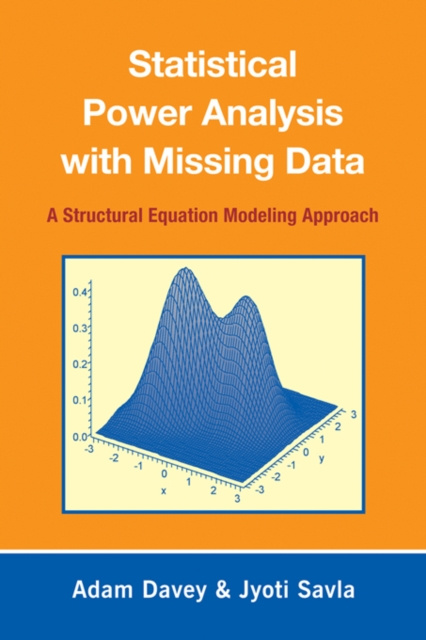
Statistical Power Analysis with Missing Data
A Structural Equation Modeling Approach
 Anglais
 176 b
176 b
Les clients ont également acheté





Statistical power analysis has revolutionized the ways in which we conduct and evaluate research. Similar developments in the statistical analysis of incomplete (missing) data are gaining more widespread applications. This volume brings statistical power and incomplete data together under a common framework, in a way that is readily accessible to those with only an introductory familiarity with structural equation modeling. It answers many practical questions such as: How missing data affects the statistical power in a study How much power is likely with different amounts and types of missing data How to increase the power of a design in the presence of missing data, and How to identify the most powerful design in the presence of missing data. Points of Reflection encourage readers to stop and test their understanding of the material. Try Me sections test one's ability to apply the material. Troubleshooting Tips help to prevent commonly encountered problems. Exercises reinforce content and Additional Readings provide sources for delving more deeply into selected topics. Numerous examples demonstrate the book's application to a variety of disciplines. Each issue is accompanied by its potential strengths and shortcomings and examples using a variety of software packages (SAS, SPSS, Stata, LISREL, AMOS, and MPlus). Syntax is provided using a single software program to promote continuity but in each case, parallel syntax using the other packages is presented in appendixes. Routines, data sets, syntax files, and links to student versions of software packages are found at www.psypress.com/davey. The worked examples in Part 2 also provide results from a wider set of estimated models. These tables, and accompanying syntax, can be used to estimate statistical power or required sample size for similar problems under a wide range of conditions. Class-tested at Temple, Virginia Tech, and Miami University of Ohio, this brief text is an ideal supplement for graduate courses in applied statistics, statistics II, intermediate or advanced statistics, experimental design, structural equation modeling, power analysis, and research methods taught in departments of psychology, human development, education, sociology, nursing, social work, gerontology and other social and health sciences. The book's applied approach will also appeal to researchers in these areas. Sections covering Fundamentals, Applications, and Extensions are designed to take readers from first steps to mastery.


À propos du livre
Anglais

Offrez ce livre dès aujourd'hui
C’est simple
1 Ajouter au panier et choisir l'option Livrer comme cadeau à la caisse. 2 Nous vous enverrons un bon d'achat 3 Le livre arrivera à l'adresse du destinataireCeci pourrait également vous intéresser





 /
/
 Livre de poche
 12.59
€
12.59
€
 /
Livre de poche
23.19
€
/
Livre de poche
23.19
€
Bonjour ! Je suis Libroamiko, votre conseiller littéraire.
Comment puis-je vous aider ?