
 Contact
 How to shop
Delivery
Shopping guide
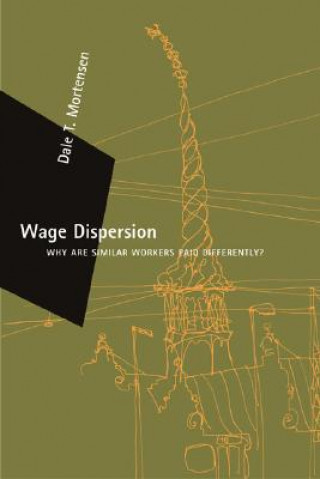
Wage Dispersion
 English
 81 b
81 b
 Delivery to Austria
Up to 30 days for returns
Customers also purchased



 /
/
 Adobe ePub DRM
 64.49
€
64.49
€

 /
/
 Paperback
25.89
€
Paperback
25.89
€







 /
Paperback
13.99
€
/
Paperback
13.99
€








 /
Paperback
74.39
€
/
Paperback
74.39
€


Why are workers with identical skills found in both "good" jobs and "bad" jobs? Why are workers who do similar jobs paid differently, contrary to standard competitive theory? Observable differences in workers doing the same job account for only 30 percent of wage variation. In Wage Dispersion, Dale Mortensen examines the reasons for pay differentials in the other 70 percent. He finds that these differentials, or wage dispersion, are largely the result of job search friction (which arises when workers do not know the wages offered by all employers) and cross-firm differences in wage policy and productivity.Mortensen examines previous theoretical explanations for wage dispersion, testing them against data from a Danish matched employer-employee database. He begins by offering a simple one-period model of the problem, then expands this basic model intertemporally to include the role of on-the-job worker search behavior. Following this, he discusses theoretical modifications that offer an explanation for the nature of observed wage dispersion, particularly the shape of cross-firm wage distribution. He then examines the hypothesis that wage policies are determined by profit-maximizing behavior and finds that the Danish data do not support it; he argues that bilateral wage bargaining is the more likely determinant. Finally, he reviews recent work that extends the basic theoretical framework to explain wage dispersion within firms.


About the book
English

Give this book today
It's easy
1 Add to cart and choose Deliver as present at the checkout 2 We'll send you a voucher 3 The book will arrive at the recipient's addressYou might also be interested in

 /
Hardback
349.89
€
/
Hardback
349.89
€


 /
Paperback
27.89
€
/
Paperback
27.89
€


 /
Paperback
16.19
€
/
Paperback
16.19
€





 /
Paperback
29.59
€
/
Paperback
29.59
€



 /
Paperback
21.99
€
/
Paperback
21.99
€



 /
Paperback
18.19
€
/
Paperback
18.19
€


Hi! I'm Libroamiko, your book advisor.
How can I help you?