
 Contact
 How to shop
Delivery
Shopping guide
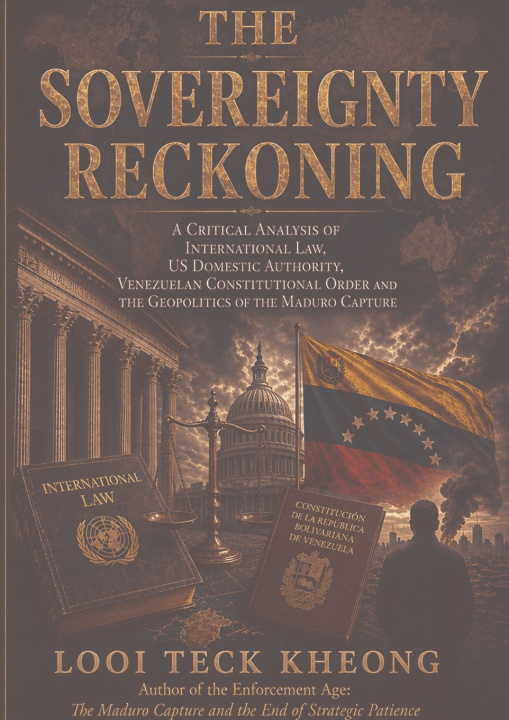
THE SOVEREIGNTY RECKONING
A Critical Analysis of International Law, US Domestic Authority, Venezuelan Constitutional Order and the Geopolitics of the Maduro Capture.
 English
 189 b
189 b
 New
New
 Delivery to Austria
Up to 30 days for returns

On 3 January 2026, shortly after midnight, United States special operations forces extracted Venezuelan President Nicolás Maduro Moros from the Miraflores Presidential Palace in Caracas. The operation brought a sitting head of state before the United States District Court for the Southern District of Florida on charges of narco-terrorism conspiracy and drug trafficking-and confronted the international legal order with questions it was never designed to answer.
The Sovereignty Reckoning is a comprehensive legal, strategic and public policy analysis of Operation Absolute Resolve and its implications for sovereignty, state immunity, domestic enforcement power and the future of international law. Drawing on more than thirty-five years of experience across law, public policy and governance, Looi Teck Kheong examines the operation through four distinct but simultaneously engaged legal orders: public international law, United States federal law, Venezuelan constitutional and criminal law, and the hemispheric dominance doctrine advanced under the Trump administration's 2026 National Security Strategy.
These legal orders do not produce a single, harmonious conclusion. The book's central finding is that the operation most probably violated international law as it presently exists, while remaining legally defensible under United States domestic law. Both conclusions can be true at the same time. The unresolved tension between them is the defining legal characteristic of what the author calls the enforcement age.
Across fourteen interconnected chapters and a comprehensive epilogue, the book examines the prohibition on the use of force under Article 2(4) of the United Nations Charter; the narco-state threshold; head-of-state immunity under the Arrest Warrant doctrine; the domestic authorities relied upon by the United States; Venezuela's constitutional order; the evidentiary architecture of the prosecution; and the geopolitical consequences for great powers, the Global South and regional organisations. A dedicated analysis considers ASEAN's principle of non-interference and its growing collision with demands for accountability where sovereignty is used to shield institutionalised criminality.
The Sovereignty Reckoning does more than identify legal contradictions. It proposes a policy programme for addressing them. Its Five Threshold Conditions Framework sets out the circumstances under which future enforcement action might acquire legal legitimacy. Its Three-Track Resolution Framework addresses the immunity-accountability paradox, while its Ten Forward Reforms offer practical pathways for developing international norms under conditions of great-power competition, contested sovereignty and state-enabled criminality. The book culminates in fourteen propositions on the state and future direction of international law.
Written for policymakers, lawyers, diplomats, judges, scholars, security professionals and readers of international affairs, The Sovereignty Reckoning asks one of the hardest questions confronting the global order: how should a system founded upon sovereign equality respond when a government weaponises sovereignty to protect criminal power?
This is not merely an account of one extraordinary operation. It is a reckoning with the widening divide between law and power-and a rigorous examination of whether international law can adapt before enforcement by force becomes the new rule.


About the book
English

Give this book today
It's easy
1 Add to cart and choose Deliver as present at the checkout 2 We'll send you a voucher 3 The book will arrive at the recipient's addressHi! I'm Libroamiko, your book advisor.
How can I help you?