
 Contact
 How to shop
Delivery
Shopping guide
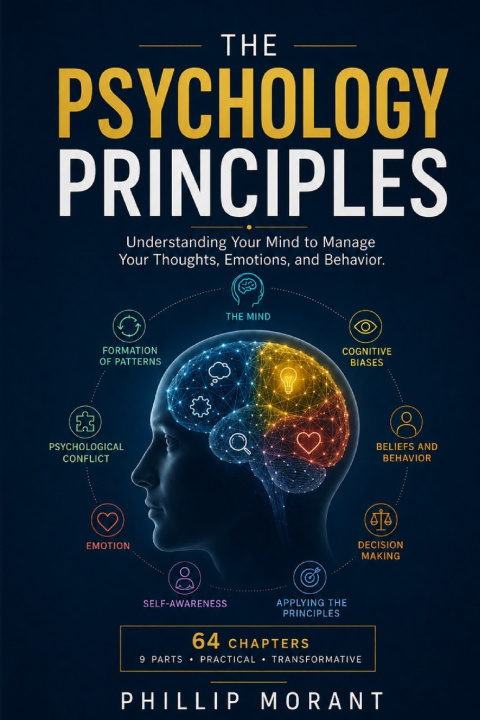
The Psychology Principles
Understanding Your Mind to Manage Your Thoughts, Emotions, and Behavior
 English
 32 b
32 b
 Coming soon
 New
New
 Delivery to Austria
Up to 30 days for returns

Every day, your reactions are shaped by processes you rarely stop to examine. You develop patterns from experience you may not consciously remember forming. You interpret events through filters and shortcuts installed long before you had any say in the matter. You protect yourself from psychological discomfort in ways that feel, from the inside, like simple common sense. You repeat behaviors that have been quietly reinforced, again and again, without ever deciding to repeat them. You hold beliefs you have never actually tested against the evidence of your own current life.
None of this makes you unusual. It makes you a human being with a mind that, like every other human mind, runs a great deal of its business automatically, beneath the surface of conscious attention, for entirely sound evolutionary reasons. The problem is not that this machinery exists. The problem is that most people go through an entire life never learning how it actually works, mistaking its automatic output for objective truth, and wondering, sometimes for years, why they keep arriving at the same difficult place by roads that each time felt, at the moment, like a fresh and reasonable choice.
This book exists to change that. The Psychology Principles is not an academic textbook, and it is not a conventional self-help book promising transformation through willpower and positive thinking alone. It is a practical field guide to the actual mechanisms of the human mind - how attention filters reality, how conditioning shapes behavior without permission, how the mind resolves the discomfort of contradiction, how emotion signals what deliberate reasoning alone cannot see, how bias quietly colors judgment, how belief organizes what a person even attempts, how decisions are made long before they are consciously reasoned through, and how genuine self-understanding, patiently built, becomes the foundation for a considerably more deliberate life.
The promise of this book is simple to state and genuinely demanding to live: when you understand what your own mind is doing, you can begin to choose what you do next. Not perfectly. Not permanently. But considerably more often than a mind left entirely unexamined ever could.
The sixty-four principles that follow are organized into nine parts, each building on the one before it. The first three parts examine the mind's basic architecture - how it processes information, forms patterns, and manages internal conflict. The next two turn to emotion and to the specific biases that quietly distort ordinary judgment. The following two examine how belief shapes behavior and how decisions are actually made, often for reasons considerably different from the ones a person would confidently report if asked. The eighth part turns the lens inward, toward the meta-skill of self-observation that makes working with everything else in this book genuinely possible. The final part is different in structure from the rest: it gathers the book's principles around nine specific difficult moments, so that understanding has somewhere concrete to land.
Each of the sixty-four chapters follows the same recurring structure: the principle itself, stated plainly; the psychological research behind it; a specific, relatable scenario showing it in ordinary life; the pattern that reveals it is actually operating; the trap it commonly produces; a genuinely useful shift in how to interpret or respond to it; a small, concrete practice; and a single sentence to carry forward. This structure is deliberate. Understanding a psychological mechanism intellectually and actually recognizing it, live, in your own mind during an ordinary Tuesday are two very different accomplishments, and this book is built to help with both.
Understanding your mind was never meant to be the destination. It was always meant to be where a more deliberate life actually begins.
Welcome to The Psychology Principles.


About the book
English
