
 Contact
 How to shop
Delivery
Shopping guide
The Continuum
Decision-Centric Architecting in the Age of Connected Systems and AI
 English
 103 b
103 b
 Coming soon
 New
New
 Delivery to Austria
Up to 30 days for returns

Every complex system is designed by people making decisions in fog. This book is about how to do that well, and how to prove it.
The blueprint everybody approved last quarter no longer matches what is being built. Requirements shift, evidence arrives late, and the diagrams turn into fossils while the real system evolves without them. Modern engineering teams are drowning in data and starving for direction: terabytes of schematics, thousands of diagrams, endless simulation results, and still nobody can answer the only question that matters. Why did we make this choice, and can we prove it works?
The Continuum names the flaw: we practise architecture as archaeology, logging decisions after the fact and building graveyards of past choices. James Wolstencroft proposes Decision-Centric Architecting, in which the system model becomes the project's navigation system and every decision, requirement, and piece of evidence stays findable, traceable, and connected from concept to operation. He calls the destination the Digital Continuum: rationale living in the same connected fabric as geometry, code, and test results. The conviction beneath it all is simple. Connectivity outranks form.
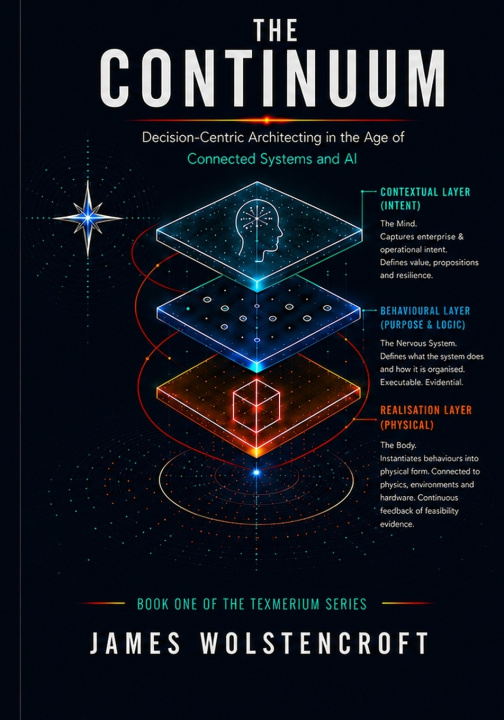
The framework rests on a four-part model: a Contextual Layer that holds intent, a Behavioural Layer that holds logic, a Realisation Layer that holds the physical design, and, surrounding and penetrating all three, the Decision Layer, the system's DNA and central memory. The other layers define the system in space. The Decision Layer defines it in time. And as generative AI begins to compose designs at machine speed, that layer becomes the thing that keeps a human able to understand, defend, and ultimately sign for what the machine produces.
Inside, you will find:
- The Decision Object: decisions as first-class digital entities linking requirements to components, so a changed requirement flags exactly which choices must be re-examined.
- The Evidence Horizon: a dashboard that separates risk (red) from unknowns (white) and sends your simulation budget to colour in the white space.
- Set-Based Design in the Digital Thread: carrying parallel solution sets and narrowing them at the Last Responsible Moment.
- Simulation as Evidence: every run a Feasibility Evidence Description that buys down a specific architectural risk.
- The Discipline Tax: the true price of every tool boundary, and the question that decides when a unified model beats a federation of specialist tools.
- The Model Vault and Accountable AI: how a human stays able to understand, defend, and sign for designs a machine composed.
The argument is grounded in forensic case studies (Ariane 5, the Boeing 737 MAX, the NHS National Programme for IT, Heathrow Terminal 5) and lands in practice: every chapter closes with a step-by-step playbook you can run on Monday morning, and a running example thread follows 2 contrasting systems from first context scan to delivery.
Written for:
CTOs and engineering directors, chief and lead systems architects, programme and project managers, senior engineers, regulators, and anyone who has watched a beautiful diagram diverge from the thing being built. The vocabulary comes from systems engineering; the method applies anywhere decisions outrun evidence, in business and policy as much as hardware and code.
The Continuum is Book 1 of the Tekmerium series. A tekmerium is a house of proofs. This book builds its first wing.


About the book
English

Give this book today
It's easy
1 Add to cart and choose Deliver as present at the checkout 2 We'll send you a voucher 3 The book will arrive at the recipient's addressHi! I'm Libroamiko, your book advisor.
How can I help you?