
 Contact
 How to shop
Delivery
Shopping guide
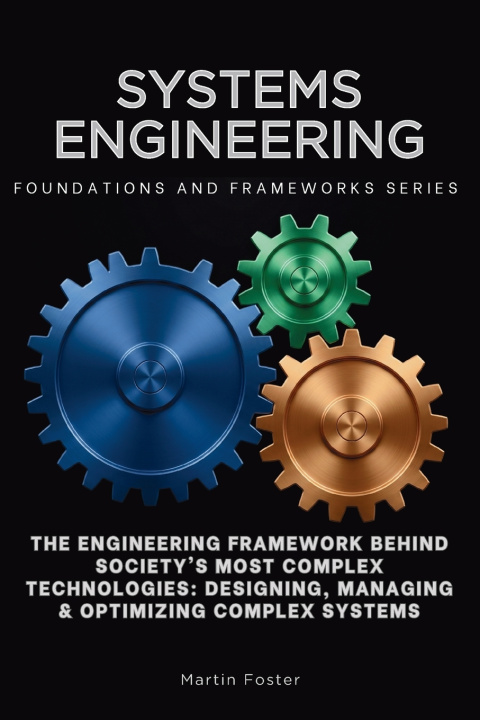
Systems Engineering, Foundations and Frameworks Series
The Engineering Framework Behind Society's Most Complex Technologies: Designing, Managing & Optimizing Complex Systems
 English
 35 b
35 b
 Coming soon
 New
New
 Delivery to Austria
Up to 30 days for returns

Systems engineering is the discipline that treats the whole system as the thing being designed, not a collection of parts. This book explains how the field works, using real projects where sound components still added up to failure.
In 1999 NASA lost the Mars Climate Orbiter because two teams used different units of measurement. Every piece of hardware performed as specified. The spacecraft burned up anyway. That space between well-built parts is the subject of these nine chapters, which follow the order in which projects actually unfold, starting with what a system is and closing with the problems reshaping the field now. Each method comes with the working knowledge you need to apply it, including when it's the wrong one.
What's inside:
- Systems thinking, emergence, lifecycle models, and how boundaries and interfaces decide where projects break
- Requirements engineering, including elicitation from stakeholders, functional versus non-functional requirements, traceability, the shall convention, and the craft of writing statements you can actually test
- Architecture and design: modularity, interface control documents, design for reliability, design for manufacturability, and model-based methods
- Modeling and simulation, from physics-based models through discrete event simulation and digital twins, plus how far you can trust a model before testing hardware
- Risk and reliability work, covering failure mode and effects analysis, fault tree analysis, probabilistic risk assessment, redundancy, human factors, and design margin
- Integration, verification, and validation, including test matrices and the difference between building the system right and building the right system
- Program management: work breakdown structures, configuration management, technical performance measures, cost and schedule trade studies, decision gates, and technical debt
- Power grids, air traffic control, spacecraft, transportation networks, and water systems
- Autonomy, artificial intelligence, cyber-physical security, interoperability standards, and sustainable design
Written for engineers moving into a systems role, project managers who want to understand what their technical leads worry about, students, and self-taught readers. No advanced degree required.
Every method arrives attached to a case. Apollo 13, Mariner 1, the Therac-25, Ariane 5, Three Mile Island, the 2003 North American blackout. You learn what FMEA is and also when to reach for it instead of a fault tree. Chapters read independently, so you can go straight to verification if that's where you're stuck, then double back to requirements later without losing the thread.
The book ends with worked answers to the end-of-chapter discussion questions, a reference section defining terms in plain language, and an annotated reading list pointing to the standard texts in the field.


About the book
English
