
 Contact
 How to shop
Delivery
Shopping guide
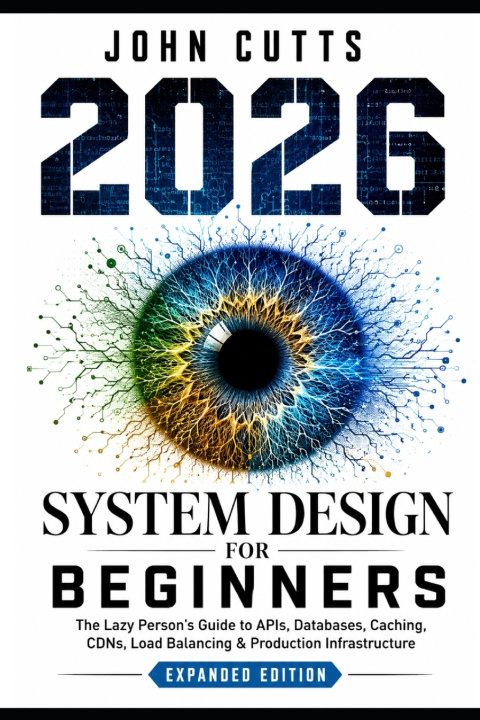
System Design For Beginners
The Lazy Person's Guide to APIs, Databases, Caching, CDNs, Load Balancing & Production Infrastructure
 English
 26 b
26 b
 New
New
 Delivery to Austria
Up to 30 days for returns

Stop freezing up in system design interviews and start thinking like a senior engineer.
Most system design resources are terrible-either too abstract to be useful or so deeply buried in theory that you finish them and still don't know what to actually do at the whiteboard. System Design for Beginners: The Lazy Person's Guide to APIs, Databases, Caching, CDNs, Load Balancing & Production Infrastructure completely changes that. Written by veteran Senior Software Architect John Cutts, this practical guide cuts through the academic fluff to give you the clear, battle-tested mental frameworks used by top engineers every day.
Whether you are a mid-level developer looking to level up or an engineer prepping for a high-stakes tech interview, this book will teach you how to build real, scalable distributed systems from scratch.
"I wrote this book because I was tired of watching talented developers freeze up in system design interviews - not because they were not smart, but because nobody had ever walked them through the practical mental models that senior engineers use every day." - John Cutts
What You Will Master Inside:
From Zero to One Million Users: Learn step-by-step how web and mobile systems scale horizontally. Discover how to use load balancers to eliminate single points of failure.
The Ultimate Database Framework: Stop guessing between SQL and NoSQL. Master ACID guarantees, replication, and sharding so you can confidently pick the right data layer.
API Design That Doesn't Suck: Demystify the distinct strengths of REST, GraphQL, and gRPC. Learn how to leverage WebSockets for real-time features and optimize service-to-service communication.
High-Speed Caching & CDNs: Explore the full caching hierarchy using Redis to slash database load. Learn to handle cache invalidation and stop dangerous failure modes like cache stampedes.
Production-Grade Reliability: Design resilient infrastructure with circuit breakers and graceful degradation. Master the three pillars of observability: metrics, structured logs, and distributed tracing.
Authentication & Authorization: Secure public endpoints using OAuth 2.0, multi-factor authentication, and stateless JWTs. Implement Role-Based Access Control (RBAC) to robustly manage user permissions.
The 5-Step Interview Framework: Ace any architecture interview with a repeatable process. Walk through real-world interview prompts like designing a URL shortener, a chat application, a rate limiter, and a social media feed.
John Cutts doesn't write from pure theory. With over a decade of experience designing systems for millions of active users, surviving database migrations, and mentoring mid-level engineers into senior roles, every concept here is battle-tested. You don't need a distributed systems PhD to build great software-you just need a clear mental framework for thinking about scale, trade-offs, and architecture.


About the book
English

Give this book today
It's easy
1 Add to cart and choose Deliver as present at the checkout 2 We'll send you a voucher 3 The book will arrive at the recipient's addressHi! I'm Libroamiko, your book advisor.
How can I help you?