
 Contact
 How to shop

Delivery
Shopping guide
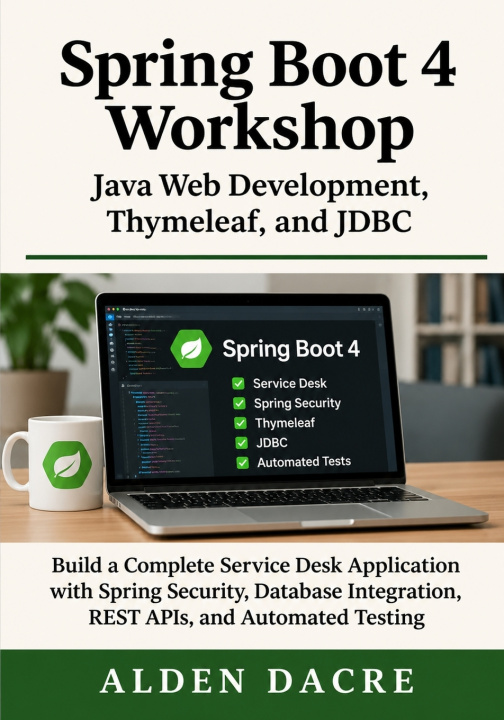
Spring Boot 4 Workshop
Java Web Development, Thymeleaf, and JDBC: Build a Complete Service Desk Application with Spring Security, Database Integration, REST APIs, and Automated Testing
 English
 41 b
 New
 Delivery to Austria
Up to 30 days for returns

A useful business application must do more than display a page. It has to accept requests, preserve data, enforce access rules, and behave predictably when something goes wrong.
For developers learning modern Java web development, the difficult part is often not any one technology. It is connecting page templates, request handlers, SQL persistence, protected routes, JSON services, and tests into one understandable system. An isolated example may work without explaining how those elements fit together.
This workshop is positioned around a service desk application: a concrete setting in which incoming tickets, forms, statuses, records, and user responsibilities provide reasons to make real design choices. It presents the project as a way to study the relationships between web pages and the backend rather than as a collection of unrelated code fragments.
Work through the design questions behind ticket-related operations, screen navigation, input validation, and API behavior. Examine the separation of responsibilities between controllers, services, and data-access code. Consider where access checks belong, how errors should be represented, and how automated verification contributes to a more trustworthy implementation.
The intended reader is a Java programmer progressing beyond isolated exercises, especially someone who wants project-based practice with backend features and user-facing pages. The service desk context helps translate abstract engineering terms into concrete application concerns.
Start with the service desk problem and develop a clearer approach to combining web, database, security, and test responsibilities in one Java application.


About the book
English

Give this book today
It's easy
1 Add to cart and choose Deliver as present at the checkout 2 We'll send you a voucher 3 The book will arrive at the recipient's addressHi! I'm Libroamiko, your book advisor.
How can I help you?