
 Contact
 How to shop
Delivery
Shopping guide
Software Engineering for AI
 English
 58 b
58 b
 Coming soon
 New
New
 Delivery to Austria
Up to 30 days for returns

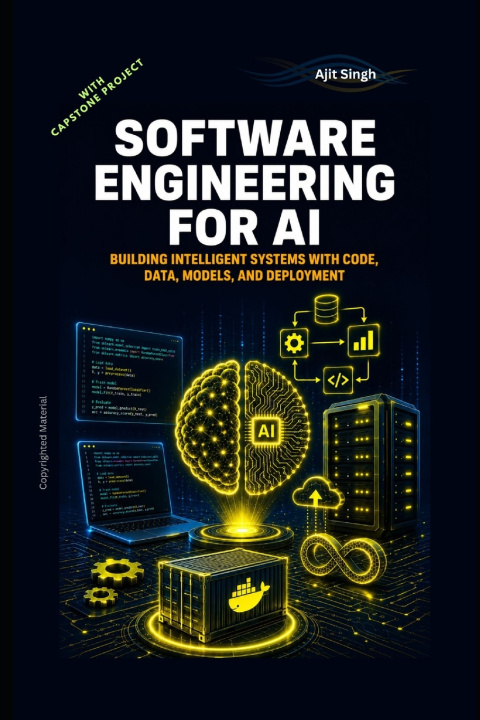
"Software Engineering for AI" is a comprehensive, meticulously structured manual designed to bridge the chasm between artificial intelligence concepts and production-grade software engineering. As the tech industry evolves, the ability to merely train an AI model is no longer sufficient. Companies demand end-to-end solutions: applications that are designed, built, deployed, and maintained with rigorous engineering standards. This book provides a clear, practical, and highly detailed roadmap for developing AI applications from scratch to final production.
Philosophy
The core philosophy of this book is "Implementation over Theory." While mathematical foundations of AI are important, they are often overemphasized at the expense of practical engineering skills. This book flips that paradigm. It operates on the belief that a software engineer or developer learns best by doing. The philosophy dictates that every concept introduced must immediately be tied to a practical application. If we will discuss an architecture, we will build it. If we will discuss an algorithm, we will implement it. The focus is strictly on creating feasible, valuable, and updated solutions that align with real-life industry requirements. AI is treated not as a magical entity, but as a software component that must be engineered, tested, containerized, and deployed within a larger system.
Key Features
1. End-to-End Lifecycle Coverage: Covers the entire spectrum from initial concept and design, through building and setting up the environment, to deployment, implementation, and final production.
2. Industry-Relevant Architecture: Detailed exploration of modern frameworks, microservices, and component-based architectures that are currently dominating the tech industry.
3. MLOps and Deployment: A heavy emphasis on Machine Learning Operations (MLOps), continuous integration/continuous deployment (CI/CD), and monitoring models in production.
4. Comprehensive Chapter Structuring: Exactly 10 chapters covering all necessary subtopics (design, model, architecture, framework, services, components, future scope, mode of operations).
5. Live Capstone Project: The final chapter is a complete Do-It-Yourself (DIY) project. It provides the full, working code for a live AI application, with step-by-step instructions on how to build, test, and deploy it.
Key Takeaways
Upon completing this book, readers will possess the following practical skills and knowledge:
1. Fundamental Mastery: A clear understanding of what AI software engineering is, its evolution, versions, types, and how it compares to traditional software systems.
2. Architectural Design: The ability to design robust, scalable architectures for AI solutions using modern frameworks and services.
3. Algorithm Implementation: The skill to translate simple, numbered algorithmic logic into functional, working code.
4. System Integration: Practical knowledge of how to wrap AI models in APIs and integrate them seamlessly into larger software ecosystems.
5. Quality Assurance: Techniques for rigorously testing AI components for performance, accuracy, and edge cases.
6. Production Deployment: Hands-on experience with containerization (e.g., Docker), orchestration (e.g., Kubernetes), and cloud deployment setups.
7. Operational Maintenance: Understanding the modes of operations required to monitor, update, and maintain AI applications in a live environment to prevent model drift and system failure.
Disclaimer: Earnest request from the Author.
Kindly go through the table of contents and refer kindle edition for a glance on the related contents.
Thank you for your kind consideration!


About the book
English
