
 Contact
 How to shop

Delivery
Shopping guide
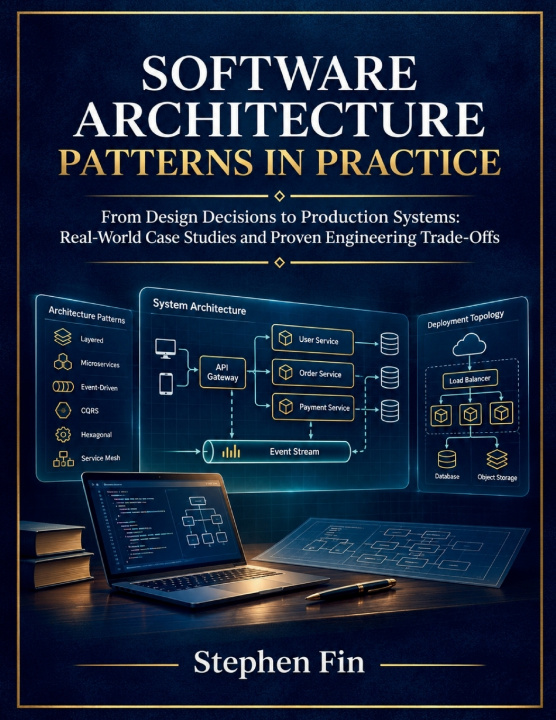
SOFTWARE ARCHITECTURE PATTERNS IN PRACTICE
From Design Decisions to Production Systems: Real-World Case Studies and Proven Engineering Trade-Offs
 English
 146 b
 Coming soon
 New
 Christmas delivery ▾
Expected in stock
Expected 17. 11. 2026
 Delivery to Austria
Up to 30 days for returns

A pattern name does not tell you who owns the data, what happens after a partial failure, or how a risky migration can be reversed.
Those decisions determine whether an architecture still works after deployment.
Software Architecture Patterns in Practice teaches a repeatable way to move from business pressure to an architectural decision you can explain, test, operate, and revisit.
Instead of presenting patterns as isolated diagrams, the book follows a practical sequence:
Diagnose the problem. Identify measurable constraints. Compare credible options. Define boundaries and ownership. Implement a small testable change. Verify its behavior. Record the decision. Revisit it when new evidence appears.
That decision-to-production approach is the book's central advantage.
Three recurring fictional systems make the consequences visible over time.
Shopline explores retail boundaries, checkout consistency, and service ownership.
TaskHarbor examines multi-tenant business software, modularization, and staged modernization.
OrderRelay investigates uncertain payment outcomes, duplicate requests, retries, asynchronous processing, and reconciliation.
Use the book to:
• Turn business pressure into measurable architectural constraints.
• Compare layered, hexagonal, and clean approaches without treating any pattern as universally correct.
• Decide when a modular monolith is sufficient and when separate services provide a real advantage.
• Define data ownership, APIs, events, queues, and consistency boundaries.
• Evaluate CQRS, event sourcing, and read models against an actual problem rather than using them by default.
• Include capacity, reliability, security, and observability in structural decisions.
• Examine retries, duplicate requests, partial failures, and asynchronous workflows before they become production incidents.
• Plan modernization through coexistence, migration, cutover, rollback, and explicit release checks.
• Use architecture decision records to preserve why a choice was made and what evidence should cause it to change.
The recurring cases show how decisions made early can create consequences much later.
A boundary chosen for convenience may complicate authorization. An optimistic retry may create a business-state problem. A migration may compile correctly and still fail its release criteria. A technically elegant pattern may cost more to operate than the problem justifies.
Diagrams, educational code examples, exercises, and worked reasoning make those trade-offs available for inspection.
Later case reviews bring multiple concerns together and ask you to make your own decision before comparing it with the explained reasoning. The goal is not to memorize a preferred architecture, but to understand why one option fits a particular set of constraints better than another.
Reusable review-intake forms, architecture decision records, release gates, and failure-drill cards also provide practical tools for technical discussions and design reviews.
The book is written for developers, technical leads, senior engineers, and engineers moving into architecture responsibilities who can already build working software and now need to justify decisions that extend beyond a single feature.
Case workloads, incidents, and performance figures are fictional teaching inputs rather than measured company results.
Start with the constraint you can demonstrate. Choose a structure you can explain. Test the consequences. Record the decision. Then define the evidence that should make you reconsider it.


About the book
English

Give this book today
It's easy
1 Add to cart and choose Deliver as present at the checkout 2 We'll send you a voucher 3 The book will arrive at the recipient's addressHi! I'm Libroamiko, your book advisor.
How can I help you?