
 Contact
 How to shop
Delivery
Shopping guide
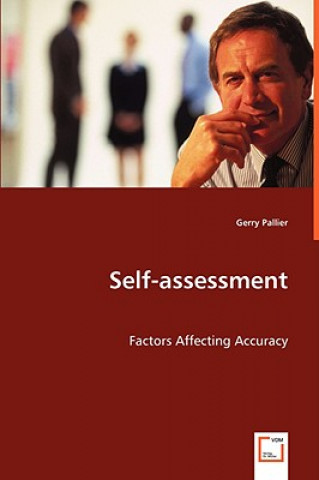
Self-assessment - Factors Affecting Accuracy
 English
 156 b
156 b
 Delivery to Austria
Up to 30 days for returns
Customers also purchased

 /
/
 Paperback
 41.59
€
41.59
€









Being able to judge the accuracy of one''s work is an important facet of human decision making. Psychological investigation into self-assessment has stemmed largely from the experimental cognitive tradition and mainly concentrates on probabilistic accounts related to rational thinking. A major aspect of this work relates to the confidence exhibited by individuals when assessing their decisions, and is thus often referred to as the ''confidence paradigm''. Another perspective has emerged in the last decade from the work of Differentialists. A robust outcome of these investigations is the existence of a ''confidence trait'' that appears to be, at least in part, a determinant of the accuracy of self-assessment. The current work takes this perspective further and examines alternative explanations for poor self-assessment. The outcomes suggest that are are a number of factors that determine accurate self-appraisal. These include question format, the difference between perceptual and cognitive tasks, gender and age. It seems that there is no single determinant of accurate self knowledge and many factors need to be accounted for when interpreting experimental findings.


About the book
English
Categories

Give this book today
It's easy
1 Add to cart and choose Deliver as present at the checkout 2 We'll send you a voucher 3 The book will arrive at the recipient's addressYou might also be interested in



 /
Paperback
18.19
€
/
Paperback
18.19
€











Hi! I'm Libroamiko, your book advisor.
How can I help you?