
 Contact
 How to shop
Delivery
Shopping guide
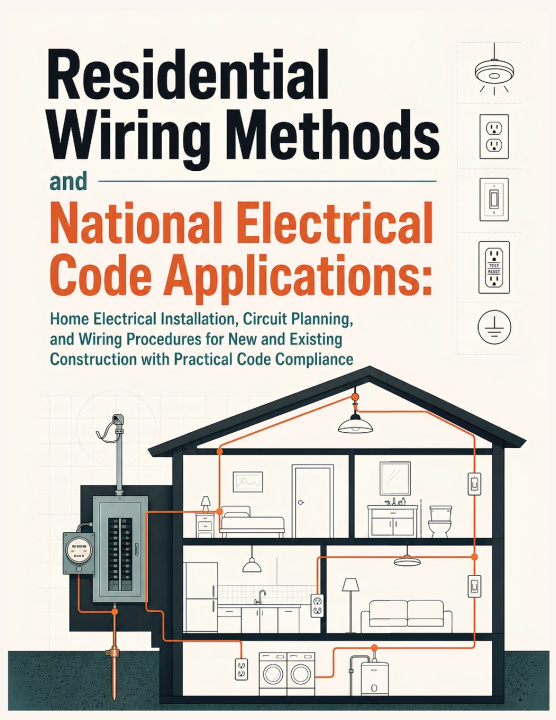
RESIDENTIAL WIRING METHODS AND NATIONAL ELECTRICAL CODE APPLICATIONS
Home Electrical Installation, Circuit Planning, and Wiring Procedures for New and Existing Construction with Practical Code Compliance
 English
 281 b
281 b
 New
New
 Delivery to Austria
Up to 30 days for returns

Plan residential electrical work from service equipment to final inspection
A floor plan can show every outlet and still leave serious questions unanswered. Which loads require dedicated circuits? How should conductors, boxes, protection, grounding, and bonding work together? What changes when the project involves an older dwelling, a service upgrade, electric vehicle charging, or standby power? The answer depends on sound electrical reasoning, an organized installation process, and the code edition actually adopted where the work occurs.
This engineering text connects circuit calculations with field procedures for new homes, additions, renovations, and corrective work. It explains how the National Electrical Code functions alongside local amendments, permits, listings, manufacturer instructions, and decisions by the authority having jurisdiction. The emphasis stays on defensible planning, safe execution, inspection readiness, and documented verification.
Inside this practical reference
- Calculate dwelling loads, service and feeder demand, conductor ampacity, voltage drop, box fill, and circuit loading.
- Trace grounding, bonding, neutral, and effective fault-current paths without confusing their separate functions.
- Plan receptacle, lighting, kitchen, laundry, bathroom, garage, outdoor, appliance, HVAC, and motor circuits.
- Apply GFCI, AFCI, surge, overcurrent, and disconnect protection to the hazards each device is intended to address.
- Select and route cables, raceways, boxes, fittings, and enclosures for concealed, exposed, damp, wet, and damage-prone locations.
- Organize rough-in, trim-out, panel work, labeling, torque records, testing, commissioning, troubleshooting, and closeout evidence.
Eighteen chapters progress from safety, electrical theory, plans, tools, and service calculations through branch-circuit design and room-specific applications. Later chapters address existing-construction assessment, rewiring and retrofit methods, electric vehicles, photovoltaics, energy storage, standby systems, integrated design, and evidence-based troubleshooting.
Every chapter includes governing equations, a complete derivation, at least three worked examples, a topic-specific reference table, two labeled technical figures, and eight practice problems with answers. The result is a calculation-centered resource that supports structured study as well as field preparation.
Who this text is for
This text is designed for electrical trainees, apprentices, construction students, early-career designers, inspectors, contractors, and experienced homeowners who want to understand how residential systems are planned and evaluated before coordinating permitted work with qualified professionals. Readers should be comfortable with basic algebra and electrical quantities.
Electrical work can cause shock, arc, fire, and equipment hazards. Always confirm the locally adopted code, amendments, licensing rules, permit requirements, product instructions, and interpretations of the authority having jurisdiction. Use this reference to turn scattered rules and calculations into one organized path from scope definition to approved installation.


About the book
English
Categories

Give this book today
It's easy
1 Add to cart and choose Deliver as present at the checkout 2 We'll send you a voucher 3 The book will arrive at the recipient's addressHi! I'm Libroamiko, your book advisor.
How can I help you?