
 Contact
 How to shop
Delivery
Shopping guide
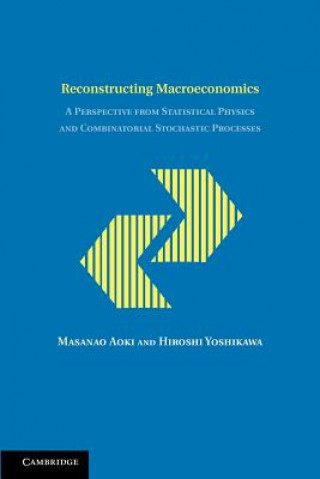
Reconstructing Macroeconomics
A Perspective from Statistical Physics and Combinatorial Stochastic Processes
 English
 154 b
154 b
 Delivery to Austria
Up to 30 days for returns
Customers also purchased





 /
/
 Paperback
 17.95
€
17.95
€


 /
Hardback
215.89
€
/
Hardback
215.89
€

In this 2007 book, the authors treat macroeconomic models as composed of large numbers of micro-units or agents of several types and explicitly discuss stochastic dynamic and combinatorial aspects of interactions among them. In mainstream macroeconomics sound microfoundations for macroeconomics have meant incorporating sophisticated intertemporal optimization by representative agents into models. Optimal growth theory, once meant to be normative, is now taught as a descriptive theory in mainstream macroeconomic courses. In neoclassical equilibria flexible prices led the economy to the state of full employment and marginal productivities are all equated. Professors Aoki and Yoshikawa contrariwise show that such equilibria are not possible in economies with a large number of agents of heterogeneous types. They employ a set of statistical dynamical tools via continuous-time Markov chains and statistical distributions of fractions of agents by types available in the new literature of combinatorial stochastic processes, to reconstruct macroeconomic models.


About the book
English
Categories

Give this book today
It's easy
1 Add to cart and choose Deliver as present at the checkout 2 We'll send you a voucher 3 The book will arrive at the recipient's addressYou might also be interested in
 /
Hardback
118.29
€
/
Hardback
118.29
€

 /
Hardback
45.59
€
/
Hardback
45.59
€

 /
Hardback
34.79
€
/
Hardback
34.79
€


 /
Paperback
8.49
€
/
Paperback
8.49
€


Hi! I'm Libroamiko, your book advisor.
How can I help you?