
 Contact
 How to shop
Delivery
Shopping guide
 English
 31 b
31 b
 New
New
 Delivery to Austria
Up to 30 days for returns

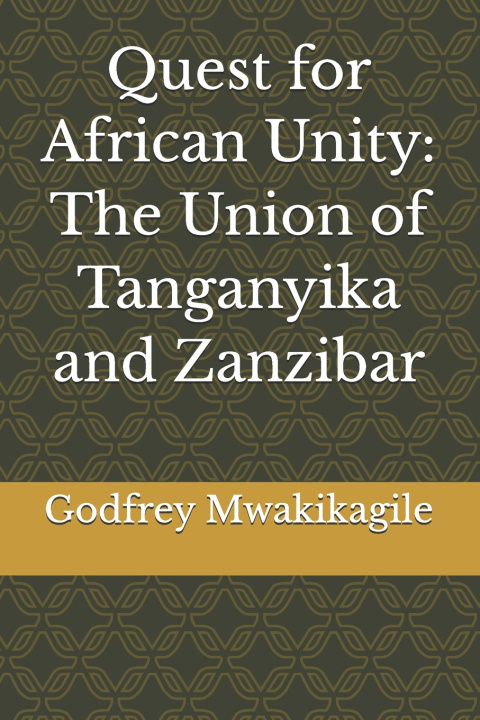
Godfrey Mwakikagile looks at the union of Tanganyika and Zanzibar engineered by President Julius Nyerere as a step towards regional federation after the three leaders of Kenya, Uganda and Tanganyika - Jomo Kenyatta, Milton Obote and Julius Nyerere - failed to form one in 1963.
At a meeting in Nairobi, Kenya, in June 1963, they signed a declaration stating that they would form a federation before the end of the year. After failing to do so, Nyerere went on to unite Tanganyika and Zanzibar four months later in April 1964 to form Tanzania. He described the union as a step towards unity on a regional and continental basis. As he put it: "If two countries can unite, then three can; if three can, then thirty can."
The union has faced some problems since it was formed more than 60 years ago, which should serve as a warning and a lesson to other countries on what they should and should not do when they want to unite.
The union is not a blueprint for regional federation. Different countries in different parts of Africa have different problems. But it is an eye opener, hence somewhat of a "guide," for other countries to be on guard against some of the pitfalls they may encounter in their quest for unity. Therefore, it is a step in the right direction towards greater unity on the continent of weak states, many of them nonviable because of their weakness as separate entities.
The work also raises some fundamental questions on why other countries have failed to unite, and why the union of Tanganyika and Zanzibar is the only union of independent states ever formed on the continent since the end of colonial rule more than 60 years ago.
One main reason is that they have not even tried to unite, although some of them have: Ghana and Guinea when Kwame Nkrumah and Sekou Toure formed the Ghana-Guinea Union, and when Modibo Keita joined them later to form the Ghana-Guinea-Mali Union, even though it was more symbolic than functional. But at least they tried. And there was the confederation of Senegambia formed by Senegal and Gambia that also collapsed.
So, the question still remains: Why is it so hard for African countries to unite? If it is impossible for them to unite because they don't want to lose their sovereignities, how was it possible for Tanganyika and Zanzibar to unite?
Those are some of the questions Mwakikagile has addressed in his book, one of the important works that address problems of unity on the continent and why there is still an imperative need for continental unification as advocated by Nkrumah more than 60 years ago when he exhorted his colleagues to unite their countries under one government before it was too late, a subject he addressed in his book "Africa Must Unite."
It is even more urgent now in this era of globalisation when Africa has become a prized possession for world powers and other industrialised countries competing for its natural resources including land as millions of Africans become landless in their own countries because of land grabs that go unchecked even under their own governments which should be the first to protect their own people from predators coming from outside to exploit the continent.
Yet, there is hope. As Nyerere said when Tanganyika united with Zanzibar more than 60 years ago: "If two countries can unite, then three can; if three can, then thirty can."
Therein lies hope for Africa. The union of Tanganyika and Zanzibar should serve as an inspiration for people in other countries across the continent and give them hope that African countries can indeed unite if there is a will to do so, echoing Nkrumah's clarion call more than 60 years ago, "Africa Must Unite."


About the book
English
Categories

Give this book today
It's easy
1 Add to cart and choose Deliver as present at the checkout 2 We'll send you a voucher 3 The book will arrive at the recipient's addressHi! I'm Libroamiko, your book advisor.
How can I help you?