
 Contact
 How to shop
Delivery
Shopping guide
 English
 27 b
27 b
 New
New
 Delivery to Austria
Up to 30 days for returns

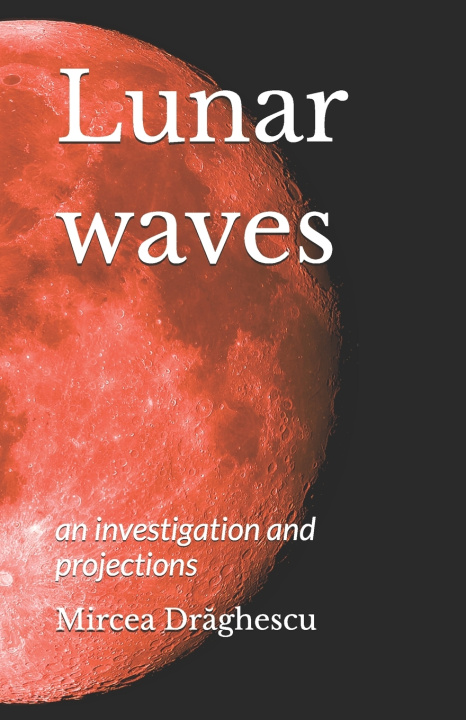
For thousands of years, humanity has watched the Moon. But what if we have been looking at the wrong phenomenon?
Across civilizations separated by continents and centuries, the same strange patterns appear again and again: lunar cycles associated with unusual human behaviour, ancient rituals performed at carefully chosen moments, mysterious metal objects found in priestly contexts, biological synchronizations, geological anomalies, and traditions describing periods when nature itself seemed to behave differently.
For nearly ten years, Mircea Drăghescu investigated these recurring clues.
His research led him from Mesopotamian astronomy and ancient Egypt to the writings of Hildegard of Bingen, Paracelsus, John Dee, Robert Fludd and Cagliostro; from forgotten archaeological discoveries to experiments conducted during the Cold War; from Soviet laboratories and the Lunokhod missions to American intelligence programmes and the work of researchers studying remote perception.
Gradually, an extraordinary hypothesis emerged.
What if the Moon does not produce the phenomenon attributed to it, but merely reveals when it occurs?
Lunar Waves explores the possibility that the Earth, Moon and Sun form part of a far more complex system of natural synchronization. Within this model, astronomical configurations would periodically favour states of increased coherence between geological, biological and perhaps even cognitive processes.
This investigation introduces a series of remarkable concepts: selenodynamic harmonics, seleno-resonant substrates, cochlears, Lunatiks, harmonic transmigrations, the Historical Convergence Index and chrono-harmonics, a hypothetical science devoted not to measuring energy, but to understanding the hidden architecture of time.
Why do certain animal species synchronize their behaviour with astonishing precision?
Why do ancient traditions repeatedly associate copper, silver and gold with particular celestial configurations?
Why were sets of strange metal spoons apparently preserved in religious and initiatory contexts?
Why did American and Soviet researchers become interested in periods of unusual cognitive performance during the Cold War?
And why do major historical upheavals sometimes appear to cluster around particular astronomical configurations?
Drawing together archaeology, astronomy, geology, biology, neuroscience, history and the physics of complex systems, Lunar Waves proposes that phenomena traditionally dismissed as unrelated may be fragments of a single forgotten pattern.
The implications are considerable.
If such synchronization exists, its applications could extend from biology and medicine to agriculture, animal behaviour, architecture and even the study of collective human systems. Artificial intelligence may eventually provide the analytical power required to test correlations across datasets too vast for any individual researcher to comprehend.
But the most unsettling possibility is also the simplest.
Perhaps ancient civilizations were not trying to control invisible forces.
Perhaps they had simply learned when to act.
We have learned to measure time with extraordinary precision.
Perhaps we have forgotten how to understand it.


About the book
English

Give this book today
It's easy
1 Add to cart and choose Deliver as present at the checkout 2 We'll send you a voucher 3 The book will arrive at the recipient's addressHi! I'm Libroamiko, your book advisor.
How can I help you?