
 Contact
 How to shop
Delivery
Shopping guide
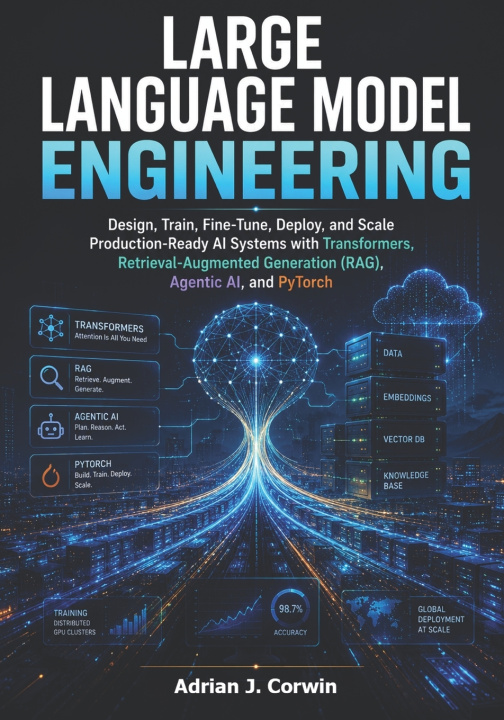
Large Language Model Engineering
Design, Train, Fine-Tune, Deploy, and Scale Production-Ready AI Systems with Transformers, Retrieval-Augmented Generation (RAG), Agentic AI, and PyTorch
 English
 58 b
58 b
 New
New
 Delivery to Austria
Up to 30 days for returns

Master the engineering discipline that powers modern artificial intelligence. Large Language Model Engineering delivers a comprehensive, production-focused guide to designing, training, fine-tuning, deploying, and scaling reliable large language model systems using Transformers, Retrieval-Augmented Generation (RAG), Agentic AI, and PyTorch.
As organizations increasingly rely on large language models for critical applications, the ability to build robust, efficient, and maintainable systems has become an essential skill for software engineers, machine learning practitioners, and technical leaders. This book bridges the gap between theoretical understanding and real-world implementation, providing the practical knowledge required to move beyond research prototypes to production-grade AI infrastructure.
Readers follow a carefully structured, continuous engineering project that builds a complete LLM ecosystem chapter by chapter. The journey begins with foundational tensor operations and embedding layers, progresses through transformer architecture and attention mechanisms, and advances to full decoder-only model construction. Subsequent chapters cover efficient pretraining workflows, parameter-efficient fine-tuning techniques including LoRA and QLoRA, instruction tuning, and preference optimization. The book then integrates retrieval-augmented generation for grounded responses, develops agentic capabilities with tool calling and memory systems, optimizes inference through quantization and KV caching, and establishes comprehensive evaluation frameworks.
Production engineering receives detailed attention throughout. Readers learn to implement scalable data pipelines, manage distributed training, design high-performance inference services, establish robust monitoring and observability, and architect enterprise platforms that support multi-tenancy, cost optimization, and governance requirements. Every major concept follows a consistent instructional approach: engineering motivation, architectural understanding, complete working implementations, production considerations, optimization strategies, common pitfalls, and professional best practices.
This book distinguishes itself through its emphasis on building production-quality systems rather than isolated demonstrations. All code examples use stable APIs, follow modern engineering conventions, and integrate into a unified codebase that grows with the reader. The content prioritizes device-agnostic design, modular architecture, comprehensive testing, and operational excellence-practices that define successful AI platforms in industry environments.
By the conclusion, readers will have constructed a functional, production-ready LLM platform encompassing the full lifecycle from data preparation through deployment and scaling. They will understand not only how modern language models work but why specific architectural and operational decisions matter. They will possess both the technical capabilities and engineering judgment required to design and maintain sophisticated LLM applications that deliver reliable performance in real-world conditions.
For professionals ready to move beyond basic tutorials and develop genuine expertise in large language model engineering, this book provides the definitive hands-on path forward. Begin building the systems that will define the next generation of artificial intelligence.


About the book
English

Give this book today
It's easy
1 Add to cart and choose Deliver as present at the checkout 2 We'll send you a voucher 3 The book will arrive at the recipient's addressHi! I'm Libroamiko, your book advisor.
How can I help you?