
 Contact
 How to shop
Delivery
Shopping guide
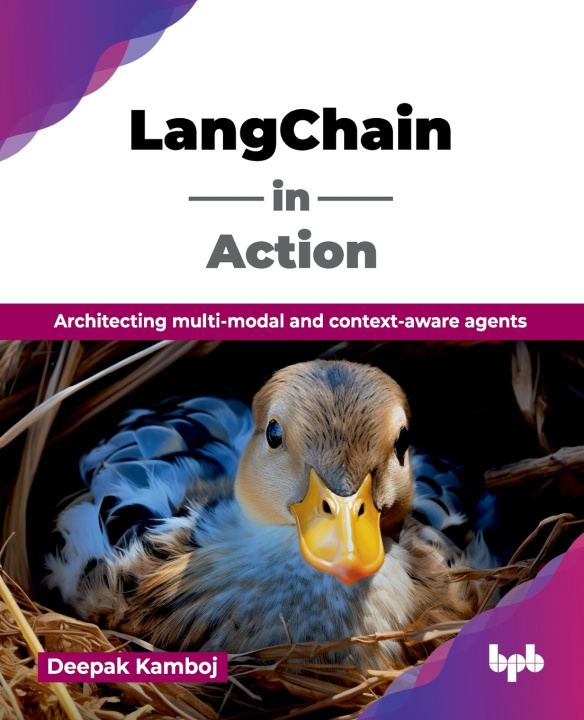
LangChain in Action
Architecting multi-modal and context-aware agents (English Edition)
 English
 81 b
81 b
 Coming soon
 New
New
 Delivery to Austria
Up to 30 days for returns

Artificial intelligence has evolved beyond chatbots and static decision trees. Enterprise agents today need to be able to see images, understand spoken language, remember context over sessions, and reason through multi-step tasks without human intervention. LangChain has emerged as the leading open-source framework for combining these capabilities into production-ready systems.
This book is a hands-on guide to building multi-modal, context-aware AI agents. Readers start by designing reusable LangChain workflows and selecting the right language models, then move into building multimodal pipelines that handle text, images, and audio together. From there, the book covers vision-enabled agents powered by GPT-4o and CLIP, voice assistants built with Whisper and Azure Speech, and agents with persistent memory that maintain context across sessions. Later chapters tackle emotion-aware interactions, retrieval-augmented generation with hybrid search, and knowledge graph fusion for advanced multi-hop reasoning. The book also explores autonomous agents that execute real-world tasks and provides a practical guide to multi-agent planning, collaboration, and evaluation.
By the end of this book, readers will be equipped to design and deploy production-grade AI agents that handle real-world complexity, agents that see, hear, remember, reason, and act with intelligence and precision.
WHAT YOU WILL LEARN
● Build modular LangChain workflows with reusable components
● Architect multimodal pipelines for text, image, and audio
● Implement speech recognition and TTS for voice-enabled agents
● Design agents with persistent memory and cross-session context
● Build RAG systems grounded in domain-specific knowledge bases
● Deploy and evaluate autonomous agents for real-world tasks
WHO THIS BOOK IS FOR
This book is for software engineers, solution architects, and AI practitioners building production-grade agents. Python proficiency and basic familiarity with LLMs or REST APIs are required, as you will transition from simple setups to complex, multi-modal, and autonomous multi-agent systems.


About the book
English

Give this book today
It's easy
1 Add to cart and choose Deliver as present at the checkout 2 We'll send you a voucher 3 The book will arrive at the recipient's addressHi! I'm Libroamiko, your book advisor.
How can I help you?