
 Contact
 How to shop
Delivery
Shopping guide
 English
 31 b
31 b
 New
New
 Delivery to Austria
Up to 30 days for returns

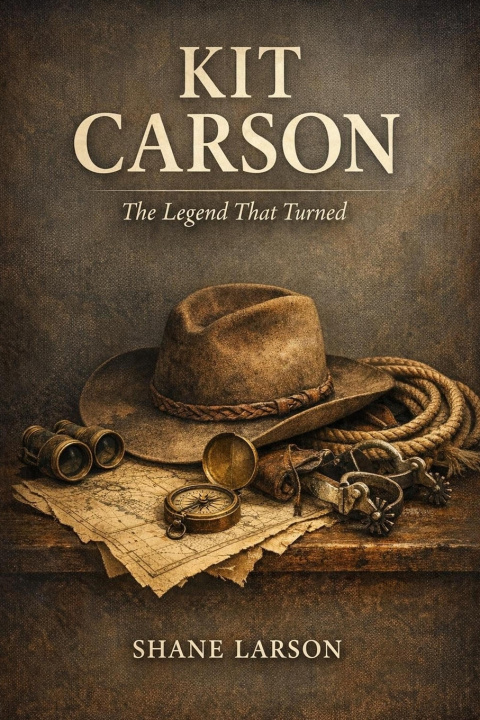
The most famous frontiersman in America could not read a word of the seventy-odd novels written about him.
In November 1849, Kit Carson guided a column of dragoons onto a camp on the Canadian River, at the end of a two-week pursuit of the raiders who had taken a woman named Ann White from the Santa Fe Trail. They were minutes too late. Among the scattered belongings, someone found a cheap paper-covered novel in which a fictional Kit Carson rescued white women from captivity, single-handedly and without fail. The real Carson, standing in the wreckage, had to be told what the book was. He was illiterate his entire life. He said later he could not stop thinking that Ann White had probably read it, and had died hoping the man in it would come.
The man was real first. A saddler's apprentice who ran away at sixteen - his master advertised a reward of one cent for his return - Carson spent the last decade of the Rocky Mountain beaver trade as a working trapper, married an Arapaho woman and later a Cheyenne woman, spoke Spanish and several Native languages, and did the route-finding and negotiating that made John C. Frémont's expeditions succeed. Frémont's reports made him famous. The dime novelists made him fictional: the hero of a shelf of books describing things he had not done, in a voice he did not have.
Then came 1863. As a colonel of New Mexico volunteers, under orders he asked more than once to be relieved of, Carson prosecuted the campaign against the Navajo not by battle but by destruction - cornfields burned, herds killed, the peach orchards of Canyon de Chelly cut down - until a starving people surrendered. What followed was the Long Walk to Bosque Redondo, where roughly a quarter of the people held there died. The same man spent a decade as Indian agent arguing on paper for the Ute and Jicarilla in his charge, and later testified against Bosque Redondo's continuation. They named a county, a national forest, and an army post after him. In this century, his name has been coming off buildings.
This book is not a defense and not a prosecution. It is the record: what Carson did, what he said about it, and what he never addressed, stated precisely, with Navajo accounts given real weight in the body of the story. And it runs the legend alongside the life - as each real event happens, you see what the novelists made of it - so that when the legend finally turns, you know exactly what it was made of.
What you'll learn:
- How a runaway apprentice became the guide who kept Frémont's expeditions alive
- What the dime novels actually said, who wrote them, and who was buying
- What happened on the Sacramento River and at San Rafael - and what Carson never explained
- Whose policy the Navajo campaign was, what Carson ordered, what he executed, and what he opposed
- The Long Walk and Bosque Redondo, from the documents and from Navajo accounts
- How a century of monuments went up, and how the reassessment took the name down
This book is for you if:
- You want evidence you can weigh, not a verdict you are handed
- You suspect the hero version and the villain version are both leaving something out
- You read frontier history for what the record actually supports, seams showing
The man and the printed man were never the same. This is the story of both.


About the book
English

Give this book today
It's easy
1 Add to cart and choose Deliver as present at the checkout 2 We'll send you a voucher 3 The book will arrive at the recipient's addressHi! I'm Libroamiko, your book advisor.
How can I help you?