
 Contact
 How to shop
Delivery
Shopping guide
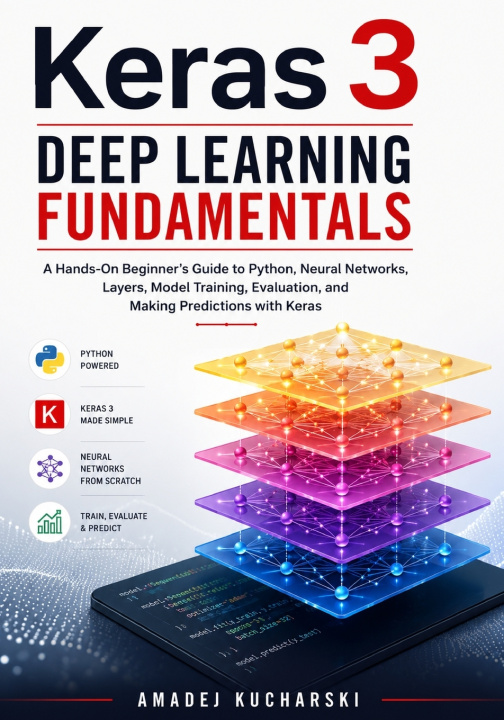
Keras 3 Deep Learning Fundamentals
A Hands-On Beginner's Guide to Python, Neural Networks, Layers, Model Training, Evaluation, and Making Predictions with Keras
 English
 54 b
54 b
 Coming soon
 New
New
 Delivery to Austria
Up to 30 days for returns

Build, train, evaluate, and use your first neural networks with Keras 3, one practical step at a time.
Deep learning can feel overwhelming when you are faced with unfamiliar terminology, mathematical explanations, and code that moves too quickly. Keras 3 Deep Learning Fundamentals gives beginners a clearer path.
This hands-on guide teaches you how to work with Keras 3 and Python by focusing on the skills you actually need to understand and build practical neural-network models. Instead of treating Keras as a collection of commands to memorize, you will learn how the complete deep learning workflow fits together, from preparing data and building layers to training, evaluating, improving, and making predictions.
You will work through a continuous Fashion-MNIST image classification project, allowing you to see how each concept contributes to a real model rather than jumping between unrelated examples.
Inside the book, you will learn how to:
Set up Python, Keras 3, and a working deep learning environment
Understand neurons, weights, biases, layers, and activation functions
Prepare and scale data for neural-network training
Build models using Keras layers and the Sequential API
Choose loss functions, optimizers, and evaluation metrics
Train models with model.fit() and understand epochs and batches
Use validation data to monitor learning
Evaluate trained models on unseen data
Recognize underfitting, overfitting, and common performance problems
Improve models by adjusting network size, learning rates, and batch sizes
Use early stopping to control training
Make predictions with trained neural networks
Convert model outputs into useful classification results
Save, load, and reuse Keras models
Bring the complete workflow together in a finished Keras 3 project
The book uses TensorFlow as the Keras backend so you can stay focused on learning Keras instead of switching between multiple frameworks. Advanced mathematics is kept to a minimum, while important concepts are explained clearly enough for you to understand what your code is doing and why.
You do not need previous deep learning experience. If you already understand basic Python and want a practical introduction to neural networks, model training, and modern Keras development, this book will help you build a strong foundation.
Stop treating deep learning as something you only read about. Start building models, training them, evaluating the results, and making real predictions with Keras 3.


About the book
English
