
 Contact
 How to shop

Delivery
Shopping guide
 English
 49 b
 Coming soon
 New
 Delivery to Austria
Up to 30 days for returns

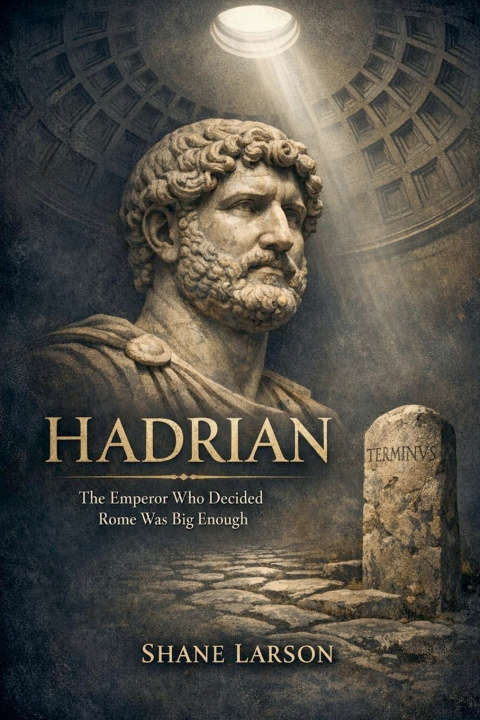
The Roman emperor modern readers love best was so hated by his own Senate that it tried to refuse him godhood.
In July 138 Hadrian lay dying at Baiae, swollen with dropsy, asking everyone who came near him for a knife. He had ruled for twenty-one years, seen more of the empire than any emperor before or after him, and spent his last two years having relatives killed. In Rome the Senate waited for him to finish so it could annul his acts and deny him the deification every emperor since Augustus had received as a matter of course. It took his heir Antoninus, pleading in person, to get it through, and one ancient explanation of the name Pius is that he had been dutiful to a dead man the Senate wanted to forget.
That gap is the subject of this book. Hadrian is the emperor of the Pantheon's dome, still the largest unreinforced concrete dome in the world; of the Wall across Britain; of the villa at Tivoli that is still being dug; of the beard every successor copied for a century; and of five lines of Latin to his departing soul. He was also the emperor whose reign opened with four ex-consuls dead without trial and closed with a ninety-year-old brother-in-law ordered to kill himself, who broke nearly every expert who contradicted him, and who could not bear to lose an argument.
Between those two Hadrians sits the thing he did that nobody had done before. Within weeks of Trajan's death he handed back Armenia, Mesopotamia and Assyria, provinces Roman soldiers had just died for, and spent the rest of his reign on the road, drilling armies that had nothing to conquer and building borders. Rome had told itself since Romulus that there would always be more. Hadrian said there would not be. He was right for three centuries, and nobody thanked him for it.
This is the man, not the reign: his temper, his friendships, his grudges, his cold marriage, his grief for a young man drowned in the Nile, and the court around him. Every claim says which source it rests on, and where that source is the Historia Augusta alone, the sentence says so.
What you'll learn:
- Why the Senate hated the emperor who ended Roman expansion, and why he was right anyway
- What a boy nicknamed the Greekling did for Athens and the Greek East once he had the power
- What the surviving text of his speech to a legion in Numidia says an army is for when conquest stops
- How the Pantheon's dome was built, and why Hadrian left another man's name on the front
- Why a dying man arranged the succession two generations ahead, picking a sixteen-year-old who became Marcus Aurelius
- How to read a biography written by one forger posing as six, and what firmer evidence sits beneath it
This book is for you if:
- You have read the novel narrated by a dying emperor and want the history beneath it
- You have stood under the oculus or walked the Wall and want the man who ordered both
- You want the poet and the killer in one person, not averaged into a sage or dismissed as a tyrant
- You want to be told what rests on an inscription, what on a coin, and what on gossip
A bonfire of 900 million sesterces in debts. A speech carved on a parade ground. A city founded for a drowned young man. Two appendices: the journeys year by year with the evidence for each stop, and a guide to every source for the reign.


About the book
English

Give this book today
It's easy
1 Add to cart and choose Deliver as present at the checkout 2 We'll send you a voucher 3 The book will arrive at the recipient's addressHi! I'm Libroamiko, your book advisor.
How can I help you?