
 Contact
 How to shop
Delivery
Shopping guide
 English
 111 b
111 b
 Delivery to Austria
Up to 30 days for returns
Customers also purchased




 /
/
 Paperback
 13.89
€
13.89
€
















 /
Paperback
9.89
€
/
Paperback
9.89
€

 /
Paperback
25.90
€
/
Paperback
25.90
€




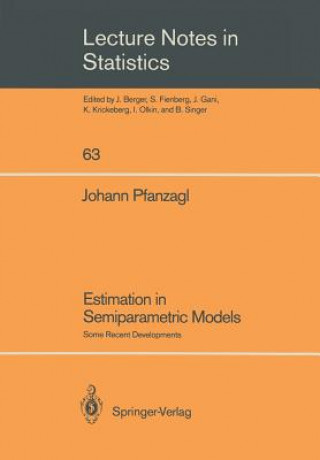
Assume one has to estimate the mean J x P( dx) (or the median of P, or any other functional t;;(P)) on the basis ofi.i.d. observations from P. Ifnothing is known about P, then the sample mean is certainly the best estimator one can think of. If P is known to be the member of a certain parametric family, say {Po: {) E e}, one can usually do better by estimating {) first, say by {)(n)(.~.), and using J XPo(n)(;r.) (dx) as an estimate for J xPo(dx). There is an "intermediate" range, where we know something about the unknown probability measure P, but less than parametric theory takes for granted. Practical problems have always led statisticians to invent estimators for such intermediate models, but it usually remained open whether these estimators are nearly optimal or not. There was one exception: The case of "adaptivity", where a "nonparametric" estimate exists which is asymptotically optimal for any parametric submodel. The standard (and for a long time only) example of such a fortunate situation was the estimation of the center of symmetry for a distribution of unknown shape.


About the book
English

Give this book today
It's easy
1 Add to cart and choose Deliver as present at the checkout 2 We'll send you a voucher 3 The book will arrive at the recipient's addressYou might also be interested in










 /
Paperback
12.29
€
/
Paperback
12.29
€





 /
Paperback
21.19
€
/
Paperback
21.19
€


 /
Hardback
224.59
€
/
Hardback
224.59
€




Hi! I'm Libroamiko, your book advisor.
How can I help you?