
 Contact
 How to shop
Delivery
Shopping guide
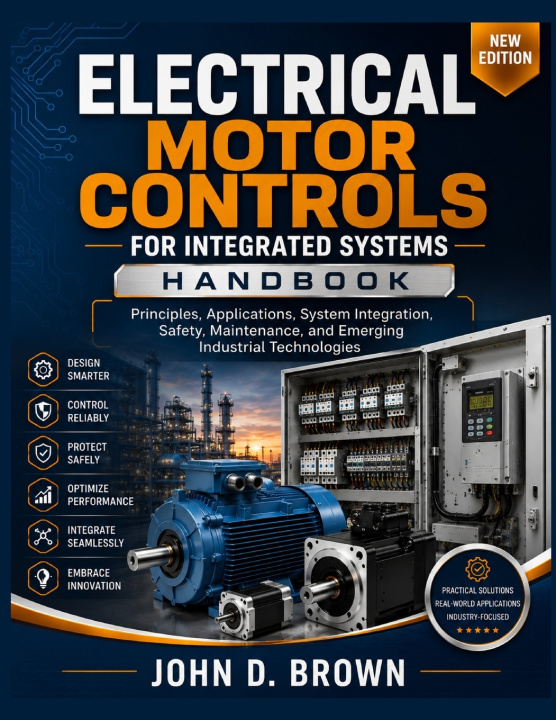
ELECTRICAL MOTOR CONTROLS FOR INTEGRATED SYSTEMS HANDBOOK
Principles, Applications, System Integration, Safety, Maintenance, and Emerging Industrial Technologies
 English
 108 b
108 b
 Coming soon
 New
New
 Delivery to Austria
Up to 30 days for returns

Electrical Motor Controls for Integrated Systems Handbook
Modern industrial systems rely on motor controls that connect electrical power, automation, protection, instrumentation, drives, PLCs, and industrial networks. Understanding how these technologies work together is essential for today's engineers, technicians, electricians, maintenance professionals, and students.
Electrical Motor Controls for Integrated Systems Handbook provides a practical and structured introduction to modern motor-control systems-from fundamental motor principles to advanced integrated automation.
Inside, you'll discover:
• DC, AC induction, synchronous, servo, and stepper motors
• Motor ratings, NEMA frames, nameplates, torque, current, and efficiency
• Electrical safety, grounding, bonding, LOTO, and motor protection
• Across-the-line and reduced-voltage starting methods
• Contactors, starters, relay logic, and ladder diagrams
• Overload, short-circuit, ground-fault, and phase-loss protection
• Variable frequency drives, PWM, V/Hz, vector control, PID, and braking
• Servo and stepper control systems, feedback devices, and motion profiles
• PLC architecture, programming fundamentals, and PLC-based motor control
• Sensors, transducers, 4-20 mA signals, and industrial instrumentation
• Modbus, EtherNet/IP, PROFINET, PROFIBUS, and other industrial networks
• SCADA, HMI, alarms, trending, and system integration
• Motor control centers (MCCs) and intelligent MCC systems
• Troubleshooting, vibration monitoring, thermal monitoring, and predictive maintenance
• Energy efficiency, harmonics, power quality, and load management
• IIoT, digital twins, edge analytics, and smart motor-control technologies
With worked examples, practice problems, answer keys, chapter summaries, a glossary, unit conversions, standards references, and an index, the book is designed to help readers move from fundamental concepts toward practical understanding of integrated motor-control systems.
Whether you are studying electrical engineering, working in industrial maintenance, designing control systems, or developing your automation skills, this handbook provides a broad foundation for understanding how modern motor-control technologies operate individually-and how they work together as part of an integrated industrial system.


About the book
English
