
 Contact
 How to shop
Delivery
Shopping guide
 English
 85 b
85 b
 New
New
 Delivery to Austria
30-day return policy

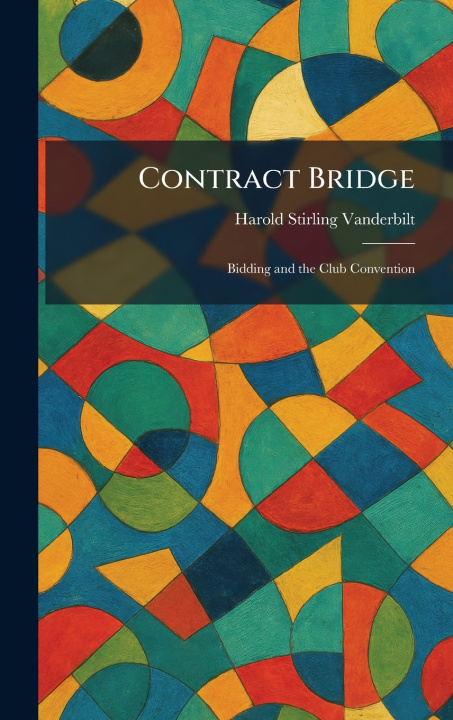
"Contract Bridge; Bidding and the Club Convention" is a foundational work in the history of card games, authored by Harold S. Vanderbilt, the figure largely credited with inventing the modern form of contract bridge. This comprehensive guide details the fundamental principles of bidding and introduces the revolutionary Club Convention, a system that fundamentally changed how players communicate the strength of their hands. The text provides a rigorous exploration of the mathematical and strategic underpinnings of bridge, offering players a structured approach to valuing hands and reaching optimal contracts.
Vanderbilt's insights delve into the nuances of various bidding scenarios, defensive play, and the importance of precise communication between partners. As a primary source from the early era of the game, this volume serves as both a historical record of the evolution of bridge and a masterclass in logical card play. Whether for the serious bridge historian or the dedicated player looking to understand the roots of contemporary bidding systems, "Contract Bridge; Bidding and the Club Convention" remains an essential reference for mastering one of the world's most enduring and intellectual pastimes.
This work has been selected by scholars as being culturally important, and is part of the knowledge base of civilization as we know it. This work was reproduced from the original artifact, and remains as true to the original work as possible. Therefore, you may see the original copyright references, library stamps (as most of these works have been housed in our most important libraries around the world), and other notations in the work.
This work is in the public domain in the United States of America, and possibly other nations. Within the United States, you may freely copy and distribute this work, as no entity (individual or corporate) has a copyright on the body of the work.
As a reproduction of a historical artifact, this work may contain missing or blurred pages, poor pictures, errant marks, etc. Scholars believe, and we concur, that this work is important enough to be preserved, reproduced, and made generally available to the public. We appreciate your support of the preservation process, and thank you for being an important part of keeping this knowledge alive and relevant.


About the book
English
Categories
