
 Contact
 How to shop
Delivery
Shopping guide
 English
 464 b
464 b
 Coming soon
 New
New
 Expected 05. 09. 2026
 Delivery to Austria
Up to 30 days for returns

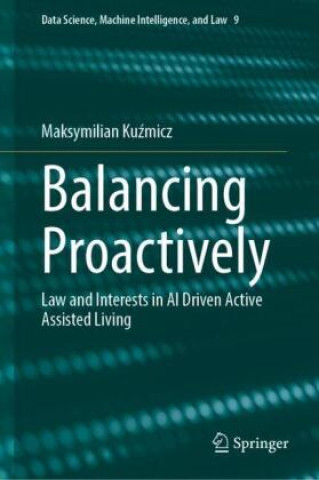
This book proposes a method for balancing and identifies appropriate legal tools for balancing in the context of AI-driven video-based Active Assisted Living (AAL) technologies - technologies integrated into computer systems that leverage artificial intelligence (AI) to assist older adults in their daily lives, enabling them to live independently and remain active. While numerous studies claim that AAL technologies are steadily improving their ability to assist individuals in need, this optimistic assessment must be weighed against a range of legal, ethical, and societal concerns. These often involve conflicts of interests, including conflicts between privacy, autonomy, safety, dignity, innovation, and effective care. One way of addressing such conflicts is through balancing. In the legal context, this raises a more specific question: What is balancing, and how can it be used to prevent or resolve conflicts?
The main focus of this book is the application of balancing as a legal method for conflict management in the AAL context, particularly in connection with European law, fundamental rights, and AAL use in private homes. The book begins by identifying key stakeholders and their primary interests. It then combines risk identification with legal analysis to propose a method for identifying potential conflicts. Subsequently, it presents two principal approaches to balancing recognised in the case law of the European Court of Human Rights and the Court of Justice of the European Union: proportionality and compromising. Each approach is analysed in detail, with particular attention to AI-driven AAL technologies.
Building on these findings, the book develops a catalogue of legal tools for balancing. It also examines the possibility of an integrated model of balancing, proposes how such a model could be constructed, and evaluates its potential role as a risk and quality management system under the AI Act.
By examining the concept of balance, methods of balancing, and legal tools for balancing, the book makes a substantial contribution to legal scholarship. It also advances research on AAL technologies by proposing a novel stakeholder classification system that combines analytical and legal approaches, identifying balancing tools applicable in the AAL context, and exploring models for risk and quality management under the AI Act.


About the book
English

Give this book today
It's easy
1 Add to cart and choose Deliver as present at the checkout 2 We'll send you a voucher 3 The book will arrive at the recipient's addressHi! I'm Libroamiko, your book advisor.
How can I help you?