
 Contact
 How to shop
Delivery
Shopping guide
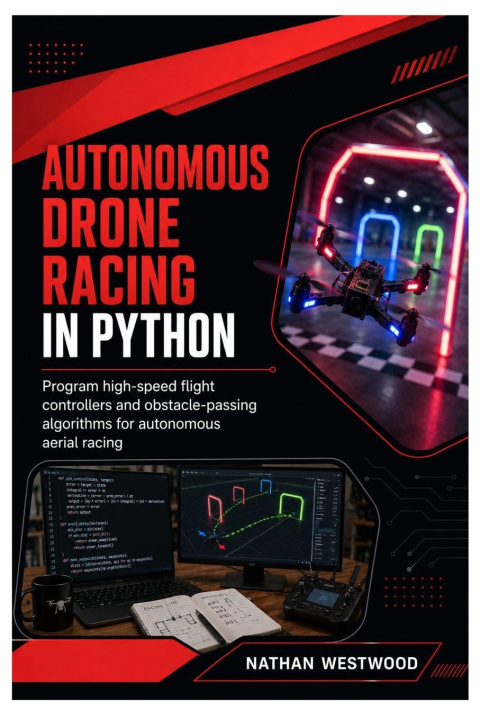
Autonomous Drone Racing in Python
Program High-Speed Flight Controllers and Obstacle-Passing Algorithms for Autonomous Aerial Racing
 English
 38 b
38 b
 New
New
 Delivery to Austria
Up to 30 days for returns

Build the software brain behind a fast, safe, and testable autonomous racing drone.
Autonomous drone racing brings together flight control, computer vision, path planning, sensor processing, and rapid decision-making. A racing drone must do more than stay in the air. It must recognise gates, estimate its motion, choose a racing line, pass obstacles, control speed, recover from errors, and continue toward the finish without a pilot steering every movement.
Autonomous Drone Racing in Python shows you how to build those abilities step by step, beginning with Python foundations and progressing toward a complete autonomous race-lap system.
This practical beginner-friendly guide will help you:
- Understand how autonomous racing drones sense, estimate, plan, control, and check safety
- Learn the main parts of a racing drone, including the flight controller, onboard computer, camera, sensors, motors, ESCs, and telemetry links
- Use Python for telemetry, gate detection, planning, logging, configuration, and supported flight commands
- Set up a development and simulation environment before moving toward real hardware
- Connect Python to a simulated drone and record basic flight information
- Design the racing software as separate modules for sensors, state estimation, vision, planning, control, safety, and logging
- Read sensor data and estimate position, velocity, orientation, altitude, and motion state
- Build a reusable computer-vision pipeline for drone camera frames
- Detect and track coloured racing gates using shape, centre, corners, size, distance, orientation, and confidence
- Model a race course, track gate order, confirm gate-passing events, and recover after missed detections
- Plan fast, smooth trajectories through gates with entry points, exit points, curves, speed profiles, and replanning
- Create obstacle-passing behaviour for narrow openings, blocked paths, moving obstacles, and emergency climb or stop actions
- Build and tune high-speed feedback controllers using PID concepts, output limits, damping, and tracking-error measurements
- Improve racing lines, lap times, gate accuracy, turn speed, and route strategy without reducing safety
- Test functions, modules, simulated courses, sensor failures, missed detections, communication failures, and controller stability
- Move carefully from simulation to bench tests, manual override checks, low-speed flights, one-gate trials, and complete-course testing
The book builds one connected racing system rather than disconnected examples. You will create a modular Python application that reads telemetry and camera data, detects gates, plans racing trajectories, follows them with a controller, records logs, and slows, stops, or recovers when unsafe conditions appear.
No previous robotics or programming experience is assumed. You can begin in simulation before owning or modifying a real aircraft. Later hardware chapters explain how to approach onboard computers, cameras, flight controllers, configuration files, bench testing, and gradual speed increases.
Safety is central throughout the book. High-speed propellers, experimental code, sensor delays, radio problems, bad lighting, weak batteries, vibration, wind, and incorrect wiring can create serious risk. The book emphasises simulation first, propeller-off bench tests, manual override, emergency-stop behaviour, staged deployment, conservative limits, logs, and local aviation rules.
Build the racing loop carefully: sense, estimate, detect, plan, control, log, and protect the drone before chasing faster lap times.

About the book
English

Give this book today
It's easy
1 Add to cart and choose Deliver as present at the checkout 2 We'll send you a voucher 3 The book will arrive at the recipient's addressHi! I'm Libroamiko, your book advisor.
How can I help you?