
 Contact
 How to shop
Delivery
Shopping guide
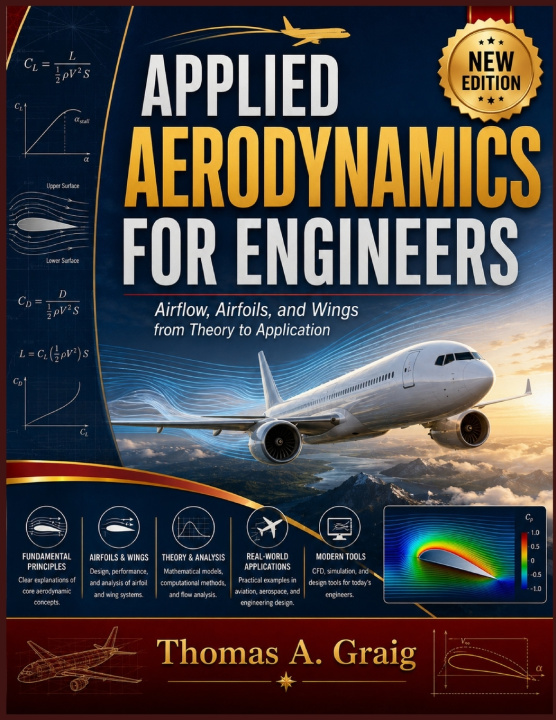
Applied Aerodynamics for Engineers
Airflow, Airfoils, and Wings from Theory to Application
 English
 372 b
372 b
 New
New
 Delivery to Austria
Up to 30 days for returns

Applied Aerodynamics for Engineers
Airflow, Airfoils, and Wings from Theory to Application
Every aircraft that takes flight, every high-speed vehicle that slices through the air, and every wind turbine that transforms moving air into energy depends on one discipline: aerodynamics.
But mastering aerodynamics requires far more than memorizing equations.
It demands understanding why air behaves the way it does, how aerodynamic forces are created, and how those principles guide real engineering design.
Applied Aerodynamics for Engineers is a comprehensive engineering textbook developed for students, aerospace engineers, mechanical engineers, researchers, and practicing professionals who want both rigorous theoretical foundations and practical engineering insight.
Rather than presenting isolated formulas, this book develops aerodynamic concepts from first principles before connecting them to real engineering applications. Readers build a complete understanding of airflow, lift generation, drag prediction, wing performance, compressible flow, computational methods, aircraft stability, propulsion systems, hypersonic flight, and modern aerodynamic design.
The progression is intentional.
You begin with the physics of fluids and aerodynamic forces before advancing through airfoil theory, finite-wing aerodynamics, boundary layers, compressible flow, supersonic and hypersonic aerodynamics, CFD fundamentals, wind-tunnel testing, optimization methods, and complete aircraft design synthesis.
Designed as both a university textbook and an enduring professional reference, this book emphasizes engineering judgment, practical interpretation, and analytical problem solving-not simply mathematical derivations.
Whether you are preparing for advanced aerospace courses, supporting research projects, designing aircraft components, or expanding your professional engineering knowledge, this volume provides the depth and clarity required to master modern aerodynamics.
Inside You'll Discover
Fundamental principles of aerodynamic forces and fluid flow
Properties of air, standard atmosphere, and similarity analysis
Fluid mechanics, Bernoulli's equation, and Navier-Stokes equations
Potential flow, circulation, vortices, and lift generation
Airfoil theory, panel methods, and finite-wing analysis
Boundary layers, transition, turbulence, separation, and stall
Drag prediction and aerodynamic performance optimization
High-lift systems and aircraft wing design
Compressible, transonic, supersonic, and hypersonic aerodynamics
Shock waves, expansion waves, and high-speed flight physics
Aircraft stability, control, and performance analysis
Wind-tunnel testing and experimental aerodynamics
Computational Fluid Dynamics (CFD) fundamentals
Rotorcraft, propeller, and wind-turbine aerodynamics
Aeroelasticity, flutter, aerodynamic noise, and optimization
Complete aircraft aerodynamic design synthesis with engineering case studies
Who This Book Is For
Aerospace Engineering students
Mechanical Engineering students
Graduate researchers
Aircraft designers
Aerodynamics engineers
CFD engineers
Flight test engineers
Wind-tunnel researchers
Professional engineers
Aviation technology professionals
Whether you're building a solid academic foundation or solving complex real-world engineering problems, Applied Aerodynamics for Engineers provides the knowledge, analytical tools, and engineering perspective needed to understand how aerodynamic principles shape modern aircraft and advanced aerospace systems.


About the book
English

Give this book today
It's easy
1 Add to cart and choose Deliver as present at the checkout 2 We'll send you a voucher 3 The book will arrive at the recipient's addressHi! I'm Libroamiko, your book advisor.
How can I help you?