
 Contact
 How to shop
Delivery
Shopping guide
 English
 111 b
111 b
 New
New
 Delivery to Austria
30-day return policy

Casting is one of the oldest and most important manufacturing processes in human history. From ancient tools and sculptures to modern automotive engines, aerospace components, railway parts, pumps, turbines, and industrial machinery, casting has played a critical role in shaping civilization. The ability to transform molten metal into complex and durable shapes has made foundries the backbone of industrial development across the world.
Yet, while the fundamentals of casting remain timeless, the industry itself is entering a new era. Traditional foundry operations-often dependent on manual expertise, trial-and-error methods, reactive maintenance, and disconnected systems-are being transformed by the power of Artificial Intelligence (AI), data analytics, automation, and digital technologies.
Today's foundries face increasing pressure to deliver higher quality, lower costs, faster production cycles, improved sustainability, and greater flexibility. Customers demand zero-defect products, energy costs continue to rise, global competition is intensifying, and skilled labor shortages are becoming more common. To meet these challenges, foundries must move beyond conventional methods and embrace intelligent manufacturing.
This is where AI becomes a game changer.
Artificial Intelligence enables foundries to learn from data, predict outcomes, optimize processes, automate inspections, improve maintenance planning, forecast demand, and support faster decision-making. When combined with sensors, Industrial IoT, robotics, computer vision, cloud computing, and digital twins, AI can transform a traditional foundry into a Smart Foundry-an agile, connected, efficient, and future-ready manufacturing ecosystem.
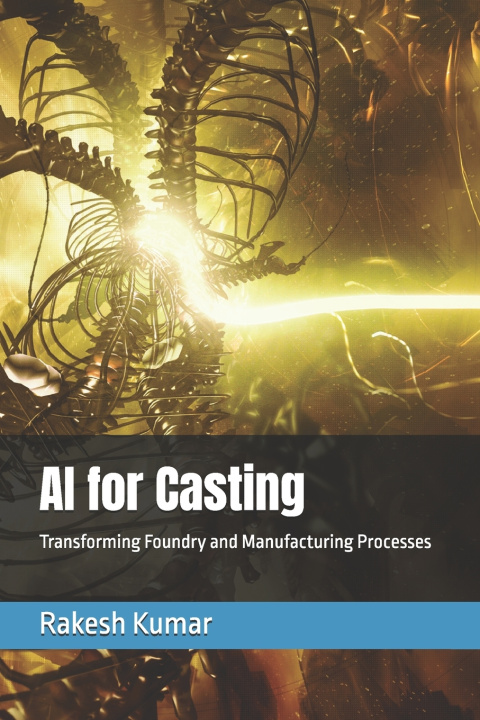
This book has been written to provide a practical and comprehensive guide to how AI is reshaping the casting industry. It bridges the gap between manufacturing knowledge and digital innovation, making advanced concepts accessible to engineers, managers, students, business leaders, and technology professionals.
Inside this book, readers will explore:
- Fundamentals of casting processes and foundry operations
- Core concepts of Artificial Intelligence and Machine Learning
- Defect prediction and quality control using AI
- Predictive maintenance for casting machines
- Energy optimization and sustainability strategies
- Demand forecasting and production planning
- Computer vision for surface defect detection
- Mold design optimization using AI
- Digital twins and real-time monitoring
- Smart Foundry end-to-end transformation case studies
- Future trends, emerging technologies, and next-decade roadmap
The future of casting will belong to organizations that combine metallurgical expertise, operational excellence, and intelligent technologies. Human experience will remain invaluable-but it will be amplified by AI-driven insights and automation.
Whether you are an engineer seeking process improvements, a manager looking for higher productivity, a student preparing for the future of manufacturing, or a business leader planning digital transformation, this book is designed to help you understand the opportunities ahead.
The foundry of the future is being built today.
Welcome to the world of AI in Casting.


About the book
English
