
 Contact
 How to shop
Delivery
Shopping guide
 English
 67 b
67 b
 New
New
 Delivery to Austria
Up to 30 days for returns

How can Aceh be understood through its own fields of knowledge?
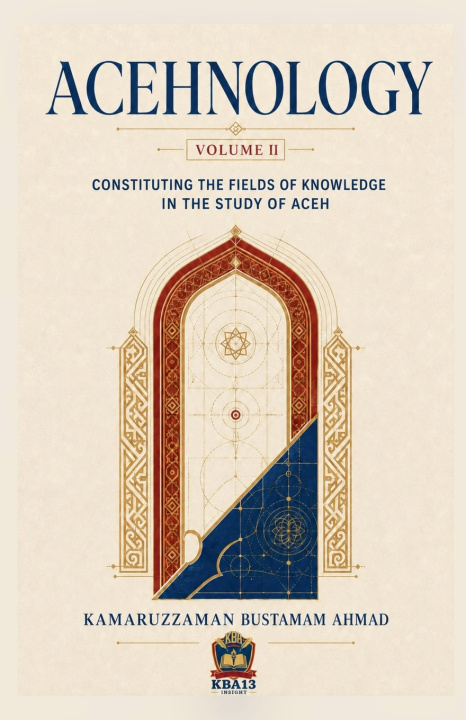
Acehnology, Volume II: Constituting the Fields of Knowledge in the Study of Aceh develops the interdisciplinary project introduced in Volume I by examining the principal disciplines through which Acehnese life, thought, culture, and society may be studied. Moving from foundational theory to the formation of scholarly fields, Kamaruzzaman Bustamam Ahmad presents Aceh not simply as a regional subject within Indonesian studies, but as an intellectual world with its own historical experience, cultural vocabulary, religious traditions, and structures of knowledge.
The volume begins by reconsidering Acehnese history and the frameworks through which it has been written. It explores how national, colonial, and regional narratives have shaped Aceh's position of Aceh within Indonesian history, the Malay world, and Southeast Asian civilization. Particular attention is given to the need to recover local sources, collective memory, historical literature, and the diverse experiences of communities across the Acehnese region.
From this historical foundation, the book enters the interconnected fields of Acehnese cosmology and philosophy. It examines ideas concerning the universe, human existence, divine reality, knowledge, spirituality, and the relationship between the visible and unseen worlds. These discussions illuminate how Islam, Sufism, local traditions, and inherited systems of meaning have influenced Acehnese understandings of life and society.
The book then develops the sociological and anthropological dimensions of Acehnology. It considers social structure, religious authority, customary institutions, identity, community, cultural transformation, and the relationship between Islam and everyday life. Rather than applying external social theories without question, the volume asks how the study of Acehnese society might also generate concepts and approaches grounded in Aceh's own historical and cultural experience.
Acehnese literature is treated as more than an artistic tradition. Hikayat, poetry, oral narratives, manuscripts, and other literary forms are examined as repositories of historical memory, moral instruction, religious knowledge, political imagination, and cultural identity. Through these sources, the book demonstrates how knowledge has been preserved and transmitted across generations.
The volume also examines religion in Aceh, including Islamic scholarship, Sufi traditions, religious institutions, authority, ritual, and the interaction between normative Islam and lived religious experience. Its final field of inquiry is Acehnese politics: the historical formation of power, leadership, resistance, sovereignty, identity, conflict, and Aceh's complex position of Aceh within Indonesia.
Together, these fields establish a broader intellectual architecture for Acehnology. History, cosmology, philosophy, sociology, anthropology, literature, religion, and politics are not presented as isolated disciplines. They are treated as interconnected ways of understanding how Acehnese civilization has developed, interpreted itself, negotiated external power, and transmitted knowledge.
This volume will be valuable to scholars, lecturers, students, researchers, and serious readers interested in Aceh history and culture, Indonesian history, Islamic studies, Sufism, religious anthropology, sociology of religion, Southeast Asian studies, Malay civilization, indigenous knowledge, postcolonial studies, literature, identity, and politics.
Each volume in The Acehnology Series may be read independently. Volume II, however, occupies a crucial place within the larger project: it transforms Acehnology from a theoretical proposition into a structured interdisciplinary field for the systematic study of Aceh.


About the book
English

Give this book today
It's easy
1 Add to cart and choose Deliver as present at the checkout 2 We'll send you a voucher 3 The book will arrive at the recipient's addressHi! I'm Libroamiko, your book advisor.
How can I help you?