
 Contact
 How to shop
Delivery
Shopping guide
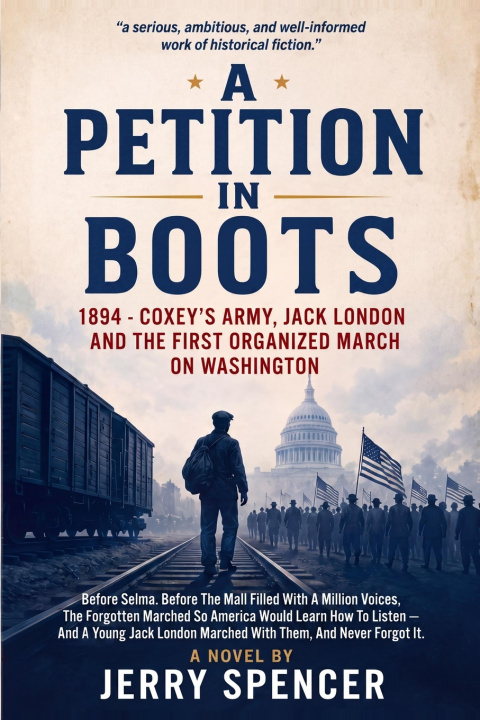
A Petition in Boots
 English
 31 b
31 b
 Coming soon
 New
New
 Date unknown
 Delivery to Austria
Up to 30 days for returns

In the spring of 1894, the country was broke and the men who built it had nothing. Banks were failing. Railroads were going under. A quarter of the working men in America had no work and no prospects. So they organized - a quarter million of them - and they marched on Washington. No army of citizens had ever done that before. They had no money, no food, and no guarantee anyone would listen. They did it anyway.
They called them Coxey's Army.
They formed up in cities from Portland to Boston, in Montana mining camps and California rail yards and Ohio factory towns. Some towns met them with parades and wagonloads of food. Women came out of farmhouses and pressed bread and cold meat into their hands. Churches opened their floors. Other towns sent deputies with ax handles. Sheriffs wired ahead to block their passage. Newspapers called them tramps, anarchists, the refuse of civilization - and wrote not a word about the men who had built those railroads or the banks that had broken them.
One of them was eighteen years old, from Oakland, California. His name was Jack London. He wasn't famous yet. He was just hungry and sharp and looking at everything with those eyes that would one day put him on the desks of twenty million readers. He marched and boated and argued around campfires and saw what the road does to a man when the man has nothing left but the road. The march made him. Hank Spencer marched beside him, and he never forgot it.
The story is bigger than Iowa. Hogan's Montana Brigade stole a Northern Pacific locomotive in the middle of the night and held it for three hundred miles before the federal marshals caught up. Fry's California contingent was stranded for weeks in the Texas desert. The Portland organizers drew a line from the march straight to the labor movement that would produce the Wobblies, the sit-down strikes, the first unemployment insurance, and the union halls that still stand in every working city in America. These men didn't just march. They invented the template - for every protest, every petition, every demand that government answer to the people who elected it.
This is Hank's book. A first-person account of the road - the railcars, the rivers, the cold camps and the baton charge at the Capitol steps. It is an homage to Jack London, written in the dust of the march that made him. And it is a tribute to every forgotten stiff who walked those roads in 1894 and never got a book written about him.
What they fought for - public works, a living wage, a government that answered to working people - was called radical madness. Every word of it became law within a generation.
Fifty years later, Hank Spencer is an old man. The war is almost over. He thinks maybe now people are ready to hear what actually happened on those roads. He thinks maybe it still matters.
It does.
Endorsed by Dr. Todd DePastino, Ph.D. (Yale), author of Citizen Hobo and editor of Jack London's The Road.
Comparable titles: News of the World by Paulette Jiles · The Cold Millions by Jess Walter · The Personal Librarian
A companion graphic novel, Two Thousand Stiffs, is available on Amazon. A multi-voice audiobook is in production.


About the book
English

Give this book today
It's easy
1 Add to cart and choose Deliver as present at the checkout 2 We'll send you a voucher 3 The book will arrive at the recipient's addressHi! I'm Libroamiko, your book advisor.
How can I help you?